


The 10 Best World Cinema of 2025
Complicated family relationships (Sentimental Value, On Becoming a Guinea Fowl), black comedies (No Other Choice), a glimpse into showbiz (Blue Moon, Kokuho) it’s an eclectic fare this year

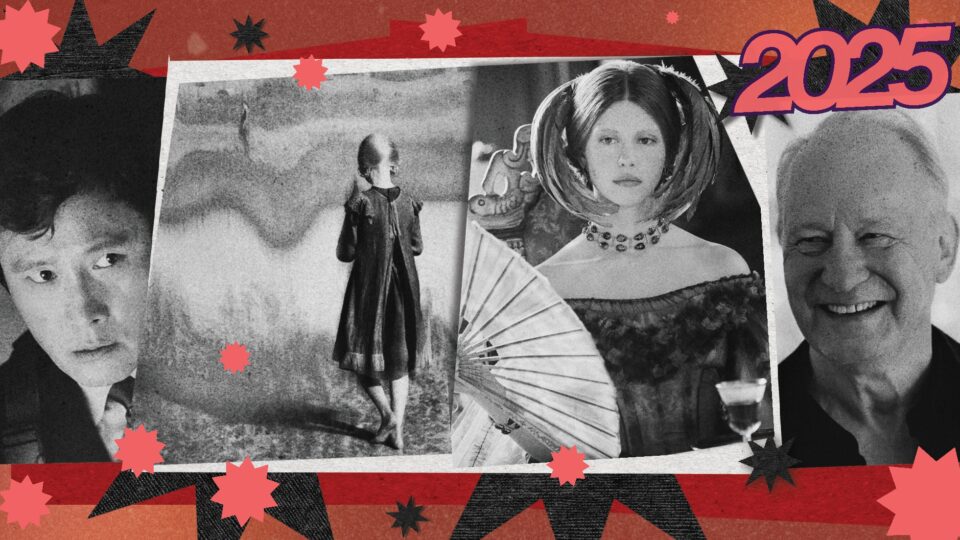
Artwork by Shradha Raul
As the credits roll signalling the end of 2025, there have been several unforgettable characters that have lived and breathed on screen. Some have lingered in our memories longer than the others, like imaginary ghosts taking up space, their existence looping on repeat in the theater of our minds.
Their impact is undeniable, making us question everything from their motives to their journeys. In order of release date, here are some of the films from around the world that stood out on the silver screen this past year.
On Becoming a Guinea Fowl (Zambia)
Directed by Rungano Nyoni
When Nyoni’s grandmother died, she penned her dream down. That dream, born out of grief, has taken the shape of a 95-minute film. Uncle Fred is dead, his body is discovered on a desolate highway by his niece, Shula. Uncle Fred has a long list of sexual assault charges to his name but as per tradition, the funeral will be held and everybody must grieve for the deceased. Shula, a victim of sexual assault herself, becomes a reluctant mourner in a performative funeral. A guinea fowl’s job is to alert the savanna of the coming danger. Here, Shula is the guinea fowl, and the danger was Uncle Fred. But now that the danger is dead, is the coast clear or will the pain and burden brought about by generational trauma and silence persist?
Train Dreams (United States)
Directed by Clint Bentley
This is a quiet film. Based on Denis Johnson’s 2011 novella, it follows the life of Robert Grainer, spanning eight decades set during the late 1800s to the slightly more modern early 1900s. Life is like a train, you get a ticket without knowing where you’ll end up. You take your seat and watch the world pass by around you. You stop for a while at each station, soaking it in. Passengers come and go, but you stay rooted to your seat, governed by inertia until you finally arrive at your destination. Robert Grainer was packed off on the Great Northern Railway as a little boy; he didn’t know where he came from or where he was going and wandered through life in a dreamlike haze. This is a tender film, grounded in the reality of what it is to take that journey on the train called life. No matter what happens, you are helpless and you can’t get off until you reach the last station. This film makes fantastic use of third-person narration, gently guiding the story along one stop at a time.
Kokuho (Japan)
Directed by Lee Sang-il
Ningen Kokuhō translates to ‘Living National Treasure,’ an award bestowed by the government of Japan to a master of a craft, working in a field dedicated to preserving art of cultural significance like music, noh and even kabuki. This 175-minute film encompasses five decades of Kikuo, a kabuki actor’s life. When 14-year-old Kikuo’s father, a yakuza boss, is killed, he is taken in as an apprentice by a renowned kabuki master and trained alongside the master’s son Shunsuke. Both of them specialize in onnagata — male actors who play the roles of women in kabuki. Their strong bond of brotherhood is tested are they are pitted against each other both on and off stage. Fame, success, skill and talent alone aren’t enough to make it in an industry where your blood determines your worth. Both Ryo Yoshizawa (Kikuo) and Ryusei Yokohama (Shunsuke) trained for a year to prepare for their roles as kabuki artists, and it shows in their performances in the film. Playing out as dramatic as a kabuki performance, Kikuo’s saga gives you a front row seat to the elusive, often ruthless, but undeniably beautiful world of kabuki.
Sentimental Value (Norway)
Directed by Joachim Trier
When their mother passes away, Nora and Agnes find their estranged film director father, Gustav, coming back into their lives. His next project is about their grandmother Karin, who killed herself in their family home when Gustav was a child. It is to be shot on location, and he’s written the lead role for Nora, who’s an actress, as a peace offering. Nora refuses, prompting Gustav to cast famous Hollywood actress, Rachel Kemp in her stead, leading to greater strain on their bonds. What follows is a realistic look at complicated relationships, generational trauma and how sometimes, creative outlets–not time–can be used to heal wounds. Gustav’s film isn’t just about his mother. Its scale stretches to warmly envelop his daughters, himself and even his grandson. One of the takeaways is that when art is something deeply personal, it’s hard for an outsider to convey those emotions, as seen from the differences in Nora’s and Rachel’s performances for the same monologue. Fantastic performances from Stellan Skarsgård, Renate Reinsve, Inga Ibsdotter Lilleaas, and Elle Fanning with Trier and Eskil Vogt’s strong screenplay is what makes Sentimental Value stand out. This film within a film is one of the most genuine portrayals of fractured familial relationships and how they can be glued back together one shattered piece at a time to create something beautiful–kintsugi at its finest.
Sound of Falling (Germany)
Directed by Mascha Schilinski
In this haunting film, the viewer is made to wander like a ghost through a farmhouse in Saxony-Anhalt, Northern Germany. Four women of different ages scattered across different times are tied together by an invisible anchor, tethering them to the same geographical location. Etched into the estate are the trapped echoes of memories, eroding the walls with generational trauma, abuse and other dark secrets that stain the wallpaper. Time flows disjointed, past and present coalescing as you witness the lives of those who occupy the space between these walls; peering through a keyhole, between the bars of a window, obscuring your view of a door that’s left slightly ajar. You come away feeling uncomfortable, an unwelcome phantom that bears witness to something not meant for an outsider’s eyes. Schilinski’s second feature film is a century of wallpaper affixed to the walls of a house that begs you not to look away, no matter how melancholic the pattern is.
No Other Choice (Korean)
Directed by Park Chan-wook
This is the Korean remake of a 2005 French film Le couperet (The Axe), which in turn was an adaptation of Donald Westlake’s novel of the same name. Finding a job is the modern version of the Labour of Hercules; today’s world has an oversaturated job market, featuring enough desperados who would gladly take anything they can get. Plus, there’s AI, which can replace their human counterparts, saving the company time and money. Park Chan-wook has expertly depicted a disgruntled laid-off employee’s sure-fire method to landing that dream job. Loyalty is seldom rewarded, as Man-su finds when he’s fired from his company. Constantly passed up wherever he applies, helplessness and desperation sink their claws into him. He’s a good man, a family man, and he needs a job. His solution? Eliminate the competition. He’s sure to land a gig if his competitors are dead. The cinematography and sound serve as another layer of throwing the audience off because you never know what to expect. Darkly comedic and mildly concerning, No Other Choice is the office worker’s guide to murder.
Frankenstein (United States)
Directed by Guillermo del Toro
Mary Shelley’s Frankenstein: The Modern Prometheus is the reanimated corpse that refuses to die, two centuries later. This book has received countless adaptations, all of which vastly differ from the source material. While del Toro’s is the closest we’ve come to getting a faithful adaptation, it undoubtedly isn’t what Mary Shelley penned down all those years ago. Instead, this film focuses on an aspect of the Creature that most adaptations choose to forget — that this patchwork galvanized corpse held together by stitches with the overpowering need to be human just wants to be accepted by his creator, Victor. As a result, in the pursuit of showcasing the humane side of the Creature, the film humanizes him a little too much. But interpretations are what keep the source material alive, and it is undeniable that this is a classic Gothic horror story done right. Finally, the Creature gets his spot in the sun.
Blue Moon (United States)
Directed by Richard Linklater
It’s a tough choice between two of Linklater’s biographical directorials Blue Moon and Nouvelle Vague, but Blue Moon wins out by an inch. Blue Moon is one night in the life of Lorenz Hart. One of Broadway’s biggest breakups was of the songwriting team Rogers and Hart who were responsible for a lot of standards like “My Funny Valentine,” “Blue Moon,” “Manhattan” and “The Lady Is a Tramp.” On the opening night of Oklahoma!, the play which would cement the partnership of Richard Rodgers and Oscar Hammerstein II, Hart departs the play early and finds himself at the bar at Sardi’s. Hart waits anxiously, despair pooling at the pit of his stomach for the inevitable rave reviews for a project he backed out of and his own declining career. When the crowd arrives and the night progresses, it becomes increasingly painful and an uncomfortable sort of funny. The kind in which you find yourself laughing in situations that are frankly bittersweet and heartbreaking. Ethan Hawke, digitally shrunk and looking quite unrecognizable in a combover, delivers a brilliant performance as Hart. Blue Moon feels like a play masquerading as a film, which perhaps makes it an apt tribute to Lorenz Hart.
The Secret Agent (Brazil)
Directed by Kleber Mendonça Filho
The story unfolds in 1977 Brazil, set against the canvas of the country’s military dictatorship spanning 21 years. Armando arrives in Recife when the Carnival is in full swing and is caught in the maelstrom. This is an unusual spy thriller, moving at a languid pace with a complicated cast of characters that merits at least three watches to untangle each thread of the film’s tapestry, all of which could very well stand as individual films themselves. Corruption, political unrest, hired hitmen, a tiger shark and a severed leg; in the world of The Secret Agent, paranoia is injected into the characters’ veins, whether they like it or not.
Hamnet (United Kingdom)
Directed by Chloé Zhao
Shakespeare is a bard who is as colorful and intriguing as the characters in his plays and whose life is as rich as his stories. But in Hamnet, it is his wife, Agnes (whose name was changed from Anne) who takes center stage, shining brighter than the spotlight. The story focuses on the courtship and marriage of Shakespeare (Paul Mescal) and Agnes (Jessie Buckley) and the tragedy that is the death of their only son. Buckley’s powerful performance is balanced by Mescal’s understated one, both perfectly depicting the two sides of people broken by grief. Dreamlike, heartbreaking and surreal, Zhao’s film feels as mystical as the woods Agnes feels at home in.