


How The Gulabi Gang Inspired BombayMami’s Upcoming Single and Merch Drop
The Indo-Swiss songstress opened up about how a group of rural feminists inspired her to create a women’s day track and merchandise drop as part of her upcoming album, ‘Peaceful Attitude’

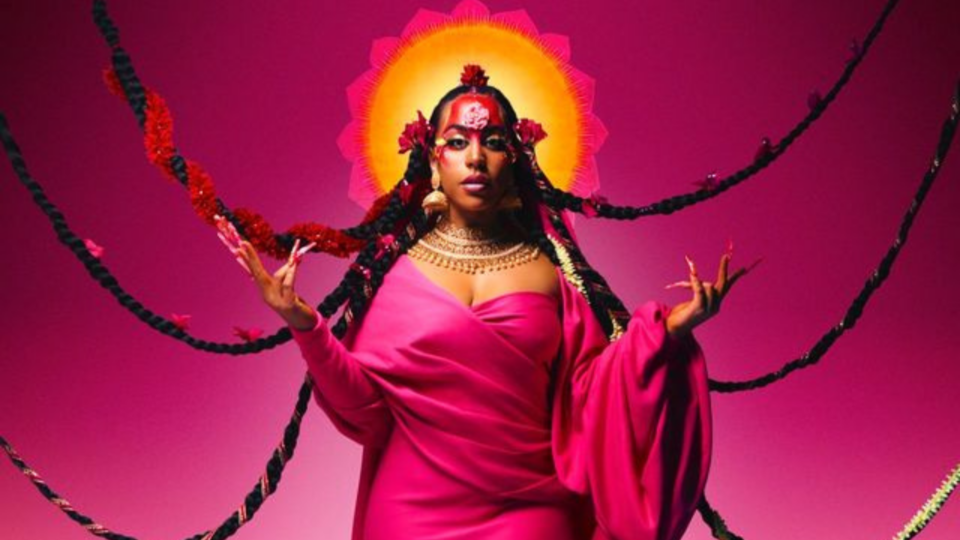
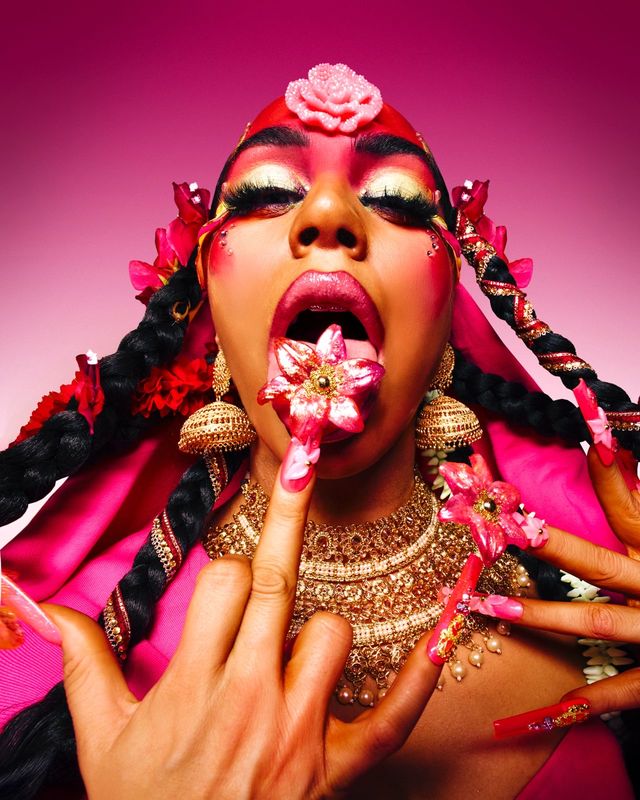
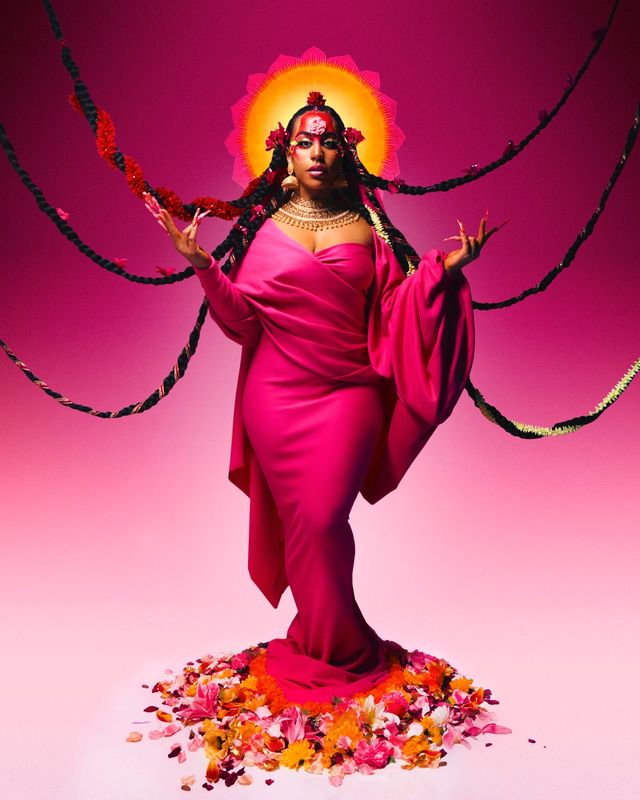
Excerpts from Bombay Mami's shoot for "Jaloux," which is part of her EP 'Peaceful Attitude.' Photo by Lilly Lytton
Is that BombayMami, dressed in a pink feline ensemble, putting up missing posters for a “kitty,” whose reward reads “autonomy” on our timelines?
The Indo-Swiss songstress has been on a lore-laden run lately. One second, she’s riding a horse, wearing a turban with a veil tucked under it, the next she’s floating across a lake in a pink, princess-esque tub as she serenades the audience with her soaring voice.
Turns out, it’s all part of the visual universe she’s threading together for her upcoming thirteen-track EP, Peaceful Attitude, out on Apr. 17, 2026, which sees the singer and creative director carving out a third space of feminine co-existence. “The album title is almost ironic. It’s like, I have a peaceful attitude…until you test my boundaries,” the multi-hyphenate tells Rolling Stone India.
And in keeping with that, her second drop off the upcoming album, “Gulabi Mantra,” is inspired by valiant stories of the Gulabi Gang, a resistance-led collective of female vigilantes from rural Uttar Pradesh, who, armed with bamboo sticks, fight against domestic abuse, sexual violence, and systemic injustice.
“I remember seeing images of women in bright pink sarees holding sticks and at first I thought, “Is this a film still?” she recalls, explaining how a research rabbit hole to build an audio-visual framework around “divine femininity” led her to discover the powerful all-female group. Dressed in a stereotypically “girly” color, pink, the lathi-wielding, saree-clad women truly embodied “divine feminine” by taking matters into their own hands, and responding to injustice with a seething rage.
Inspired by their vigor and courage, “Gulabi Mantra” became BombayMami’s way of navigating autonomy. Infused with afro-beat rhythms and syncopating Carnatic riffs, the two-minute track echoes a message loud and clear through its catchy hook: “My Body. My Voice. My Kitty. My Choice.”
“Bodily autonomy means I decide the terms,” the singer affirmed. “I don’t want to be reduced to a hypersexual fantasy. But I’m also not afraid of being sexual. I love feeling sexy. I love expressing that part of myself. That’s not weakness…that’s power. The difference is choice,” she elaborates.
Reduced to objects, burdened by stereotypes, and caged by conservative dogmas, women are far too often pushed into socio-political submission. Be it governments waging war on bodily autonomy, law enforcers “normalizing” sexual assault and violence, or social media popularizing problematic trends like “trad-wife” and “body facism,” the freedom of choice has historically been out of grasp for most women.
“Growing up, you learn very early that your body is watched. Commented on. Protected. Judged. Desired. Sometimes all at once. And as a performer, that becomes amplified. People feel entitled to your image, your sexuality, your energy,” she reflected.
Rage, anger, defiance, and ownership; these are all aspects of the female emotional spectrum that have been contorted into a villainized lens. And that’s exactly what BombayMami is trying to challenge. “There’s this expectation, especially in South Asian culture, that women should be calm, graceful, forgiving. Like Lakshmi all the time. But we forget that the same culture also gave us Kali,” she states. “For me, as a Swiss-Indian woman moving between worlds, that duality hit deeply. The softness of pink. The hardness of resistance.”
Set against a bubblegum pink sunset, the cover art for “Gulabi Mantra” has the artist sitting atop a tiger, trishul in hand, serving celestial bombshell realness. “Visually, I drew inspiration from Durga and her symbolism: Strength with serenity, beauty with danger, stillness with power. The tiger represents instinct and raw force. Sitting on it represents mastery. Controlled fire. It felt important to embody that instead of just referencing it.” she mentions.
Slated for release on International Women’s Day, the anthemic single also comes with a limited-edition merch drop consisting of “kitty” printed socks, Om-shaped bindis, and a matching tote bag. “Everything, from the cover art to the merch, carries that same energy: Feminine, but not fragile,” she pointed out. Even the tiniest details, such as typography, were used to create artistic semblance, rather than divergence: “I didn’t want the visuals to feel separate from the music. It’s one universe,” she vocalizes. Proceeds from the same will be going to UK-based and Indian women’s rights charities like SHEWISE and ActionAid India.
Tying it back to her Gulabi beginnings, the singer seeks strength in tales of female infallibility: “There’s something extremely powerful about rural women, often dismissed, often underestimated, becoming their own protection system,” she observes. Dismantling hypersexual fantasies, she hopes to spotlight the female gaze, which reveres sexuality rather than fetishizing it, “I can embody goddess energy…strength, protection, fierceness and I can move my hips and feel sensual. Those things are not contradictions. They coexist.”