



Veteran DJ Rummy Sharma on What Will Shape The Next Wave of Indian Electronic Music
As The Bootcamp Goa enters its fifth season, the founder reflects on a generation of Indian DJs and producers hungry enough to go DAW-less


French-Indian DJ Rummy Sharma is the founder of The Bootcamp Goa. Photo: Courtesy of the artist
There is a particular kind of pressure that comes with running a program that others have begun to depend on. French-Indian DJ-producer Rummy Sharma — founder of 3is’ The Bootcamp Goa — has felt it build steadily over five seasons of the electronic music-focused education initiative. What began as an experiment in bringing serious electronic music education to India is now seeing participation from artists who want to be challenged. “I promote it for the people who are really hungry to learn,” Sharma tells Rolling Stone India over a Zoom call from Morjim, Goa, ahead of the camp. “Not for networking. Not to get a slot at [Berlin festival and techno-parade] Rave The Planet. To learn.”
Now in its fifth iteration — running from Mar. 9 to 21, 2026, in Morjim, Goa — the Bootcamp has grown from an inaugural batch of 16 or 17 students to a hard cap of 45 participants. Before they can be accepted into the programme, every applicant is thoroughly interviewed by Sharma, who looks for mindset and skill level.
One of the more deliberate shifts in The Bootcamp Goa Season 5 has been a pivot away from international mentors in favor of India’s own. This year’s mentors include Gaurav Raina aka Grain of Midival Punditz, Ma Faiza, Anyasa, Audiogramme, Komorebi, Hybrid Protokol, Clement Dsouza, Navendu, Seventh Sea and music & media company The Big Beat’s Malvika Nanda, among others. The decision, Sharma says, reflects a new confidence in what the Indian electronic music scene can deliver.
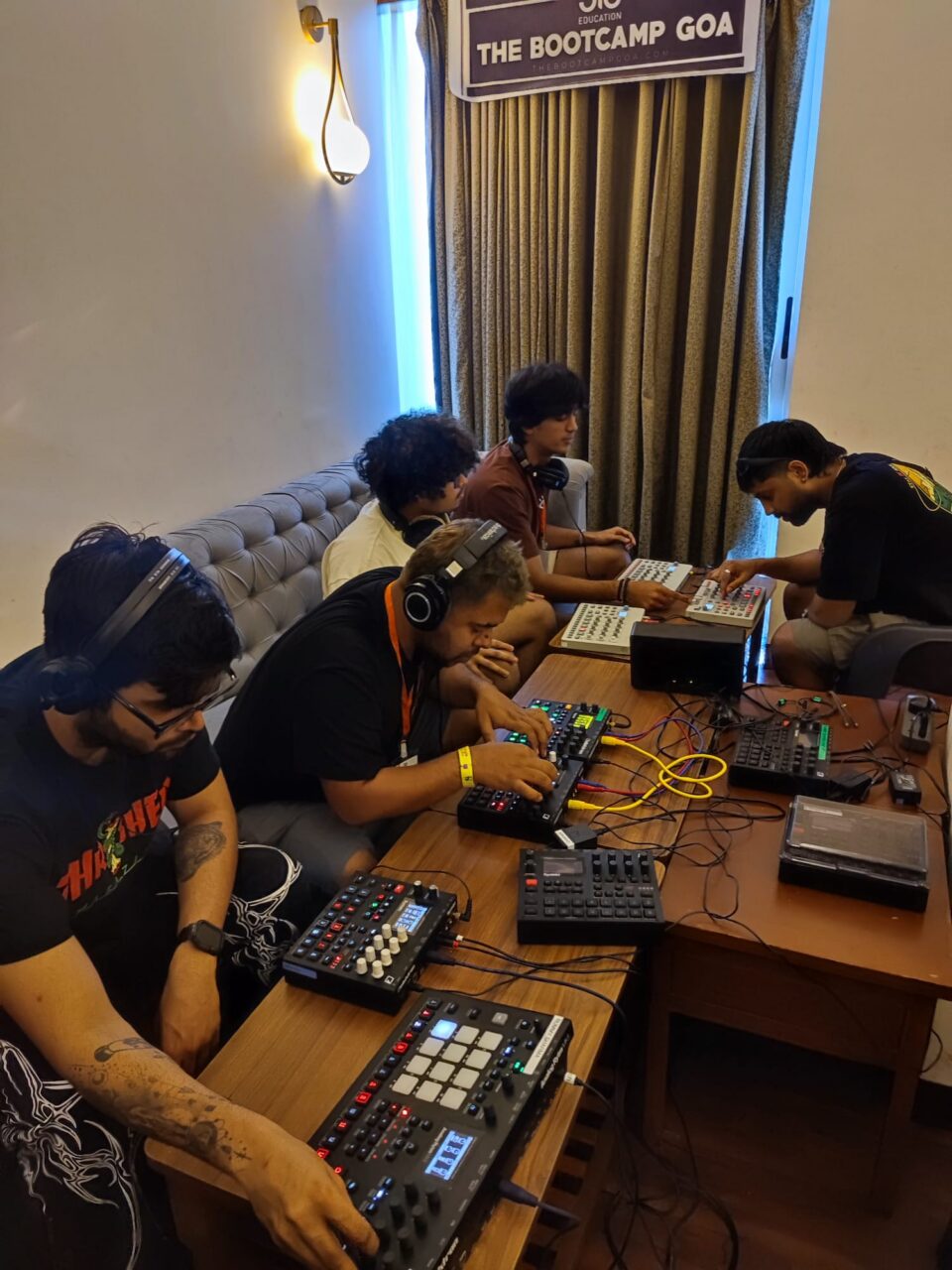
“Indian mentors are strong enough, they can deliver,” he says. Past seasons brought in figures like Berlin-based producer Robert Babicz, whose experience at the Bootcamp extended well beyond the fortnight’s program. Sharma recalls Babicz collaborating with percussionist-producer Krishna Kishor, who had been a drummer for A.R. Rahman‘s ensemble, taking recordings of Konkani spoken word and Indian percussion back to Europe, and fashioning them into new work. “He got that influence. He carried it back — and it went international,” Sharma says. That kind of cross-pollination continues to be a feature of the camp, with this season including an Italian couple, who have enrolled to learn DAW-less production and advanced Ableton.
Among the most in-demand courses over the years has been DAW-less performance — the practice of creating and performing music live, without the scaffolding of a digital audio workstation. The Bootcamp introduced DAW-less modules roughly three years ago. This season, demand has outpaced available equipment. The advanced DAW-less module alone has enrolled 10 participants, while the foundational DAW-less DJing and Ableton tracks each have eight, and the VJing module has seven or eight enrolled students. “I had to cut down on applications because we don’t have enough equipment. Every student needs their own machine,” Sharma says.
For Sharma, DAW-less performance represents a necessary response to a deeper problem facing the industry. “DJing and digital music production is like learning the ABCs. It’s essential. But everyone is a DJ now. Everyone is a digital music producer. And AI is making it more difficult to stand out,” he explains. The way he sees it, the DAW-less participants are signing up to challenge themselves and grow.

“People are getting tired of influencer DJs,” he says, drawing a line between artists who perform and those who merely push play. “[As] the live act — with DAW-less, with hardware — people know this person is real. There’s no ghost production. There’s no copied mix. And in older times, when I was DJing in the Nineties, people saw the turntables as an art. But as it became more and more common, it became boring.” He believes that art is returning, driven partly by audiences and partly by artists who are serious enough to seek it out. A modest DAW-less setup is increasingly accessible, according to Sharma. He points out that these days, a single hardware machine costing around ₹30,000 can be built out to a full-performance rig for four to five lakh rupees.
Each season, three to four students take up turntablism — the most demanding of the Bootcamp’s disciplines, and the one closest to Sharma’s own heart. “Personally, I’m a turntablist, or I’d like to be,” he says, half-laughing. The form has historically struggled to take root in India: access to records and to properly maintained decks has been challenging. But the tide is turning slowly, and the Bootcamp’s greatest asset in this area is one of its core mentors — Skipster, who won the IDA World DJ Championship in London in December 2025 alongside DJ Johney.
“He’s [Skipster] the best example India can ever have, or the world can ever have,” Sharma says, adding that Skipster is now a permanent part of The Bootcamp team. “He’s so versatile. So delicate. He’s possibly one of the best teachers on this planet.” For Sharma, the students who pursue turntablism share the no-shortcuts determination similar to those drawn to DAW-less modules. “They want to enjoy the journey before the destination.”
A newer addition to the Bootcamp’s offering is a fully structured VJing module. While the program introduced VJ masterclasses in earlier seasons, Season 5 marks the first time a complete beginner’s track has been offered: a six-day, 24-hour course led by visual artist Yash Chandak.
The module’s uptake reflects something broader happening at the intersection of sound and creative direction. Several students enrolled in DAW-less advanced are simultaneously taking up VJing and building toward a practice where live music and visuals are generated together in real time. “You can see the sound,” he says. “When you see something in a club and it’s a perfect match for the music being played, it’s fantastic.”
He’s seen artists with synthesizers and groove boxes connected via software to a projector, translating audio signals directly into graphics. “It catches up a lot in Europe,” Sharma says. The Bootcamp is working to accelerate that trend in India, where club infrastructure is shifting but willing. Sharma — who runs film education programmes in Europe through his 3is organisation — is candid about his own desire to one day learn the form himself. “I wish I had the talent. Maybe next year.”

Ask Sharma about the students who have passed through the Bootcamp’s doors and gone on to forge international careers, and he speaks with the measured pride of someone watching a long-term bet pay off. He cites Mashter aka Mash Mendiratta — now performing regularly in Berlin and Munich, consistently invited back — and Bahaar, who has played Rave The Planet, representing India in Berlin as well. He also talks about Ankur Vedh Batra, a first-season student turned core team member, and about Dotdat, whom Sharma describes as the next Arjun Vagale for his adventurous sonic choices.
“If I go and play in any club in France or Germany or Italy and I say I’m from India, there was a time people knew Rummy Sharma. Now they say, ‘Do you know Arjun Vagale?’ His name in the techno scene is very big,” Sharma says with a laugh.
Sharma projects that within two years, India will have “at least 100 serious DAW-less artists,” and he believes “40 to 50 percent” of them will have come through The Bootcamp. He adds, “Indians are hungry to learn. They don’t have the infrastructure or the access, but they are hungry. And that hunger is everything.”


