


Inside the Making of ‘Dhurandhar’s Explosive Soundtrack
From pairing Diljit Dosanjh and Hanumankind to Reble rapping on an R.D. Burman classic to powerful tracks by Madhubanti Bagchi and Simran Choudhary, Bollywood has a new hit OST

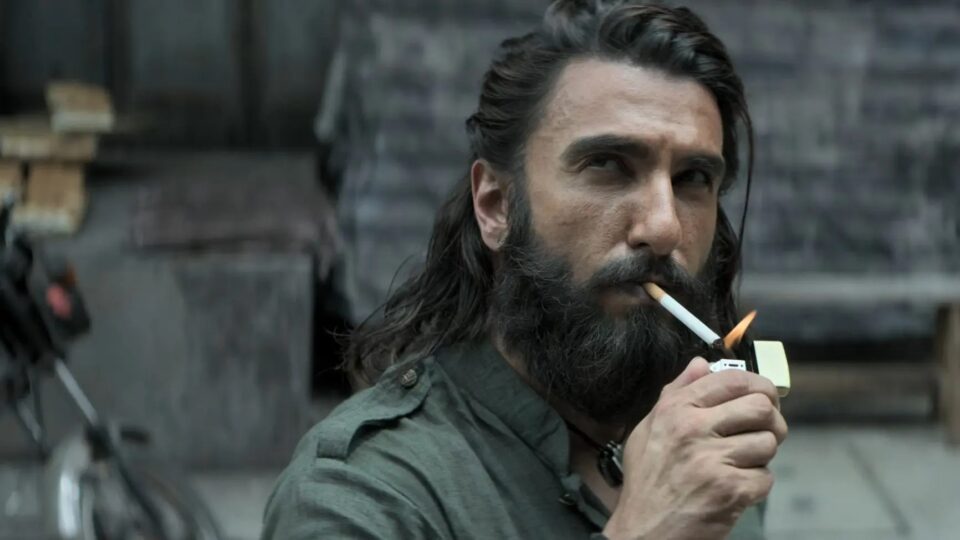
Ranveer Singh in 'Dhurandhar.' Photo: B62 Studios/Jio Studios
Bollywood action movie Dhurandhar has stirred up plenty of critical acclaim, box office revenue, and controversial opinions, but the Aditya Dhar-directed film’s music is spawning a fanbase of its own.
Rightly so, considering composer Shashwat Sachdev dug into righteous rap, dollops of synth-led pop that turn into stomping numbers and even flipped a few beloved Bollywood songs into high-BPM ragers. Outside of standout songs like the title track, “Ishq Jalakar – Karvaan” and the background score, actor Akshaye Khanna’s entry as Rehman Dakait set to Bahraini rapper Flipperachi’s “Fa9la” has led to the song blowing up as a viral favorite on social media, even topping streaming charts like Apple Music’s Top 100: India and Spotify’s Viral 50 – India.
Fresh off Sachdev’s work on Netflix series The Ba***ds of Bollywood, which gave us hits like “Ghafoor,” the Dhurandhar soundtrack rounds out 2025 as a year of hits for the National Film Award-winning composer who has worked with filmmaker Aditya Dhar on projects like Uri: The Surgical Strike. Sachdev tells Rolling Stone India, “From the beginning, Aditya and I understood that Dhurandhar is a very serious film in its themes, but the audience should still feel entertained by its seriousness. We didn’t want the music to feel like a lesson or a political document. We wanted intensity, but with movement, rhythm and play.”
To that end, he assembled a star cast of artists. The title track, which was first heard in the Dhurandhar teaser earlier this year, brought together rap star Hanumankind (working on his first theatrical Bollywood soundtrack), Punjabi star voice Jasmine Sandlas and singer Sudhir Yaduvanshi. Arijit Singh lights up “Gehra Hua,” the love song on the soundtrack, while Diljit Dosanjh adds grit to the heady “Teri Ni Kararan,” and, in a collab no one saw coming, even teams up with Hanumankind for the seemingly Irish folk-inspired “Ez-Ez” alongside Ranveer Singh. Meghalaya’s rap maverick Reble hops on “Run Down The City – Monica,” plus “Naal Nachna” with Punjabi artist Afsana Khan and “Move (Yeh Ishq Ishq)” with Sonu Nigam. Elsewhere, Sandlas and Madhubanti Bagchi match up on “Shararat” and folk-informed pop star Simran Choudhary leads “Lutt Le Gaya” as singer and lyricist.
If there’s been another runaway hit, it’s the breezy yet groovy “Ishq Jalakar (Karvaan)” sung by Shahzad Ali, Subhadeep Das Chowdhury, and Armaan Khan. A key approach has been Sachdev and Dhar drawing from evergreen Indian songs (it helps that Saregama, the label that released the Dhurandhar soundtrack, owns the copyright to most of India’s iconic and yesteryear hits) like the title track recreating the 1995 Charanjit Ahuja-composed song “Na Dil De Pardesi Nu” sung by Muhammad Sadiq and Ranjit Kaur, with lyrics written by Babu Singh Maan to introduce the high-stakes world of Dhurandhar. “Ishq Jalakar” is based on “Na to Karvan Ki Talash Hai” sung by Mohammed Rafi, with music by Roshan and lyrics by Sahir Ludhianvi. Reble raps over R.D. Burman and Asha Bhosle’s “Piya Tu Ab To Aja” from 1971 movie Caravan on “Run Down The City – Monica” and “Move (Yeh Ishq Ishq)” also draws from “Yeh Hai Ishq Ishq” composed by Roshan with lyrics by Ludhianvi, from the 1960 movie Barsaat Ki Raat. Bagchi returns to lead the hypnotic, synth-driven dancefloor jam “Ramba Ho,” a recreation of Bappi Lahiri-composed, Usha Uthup-sung “Ramba Ho Ho Ho Samba Ho Ho Ho” from 1981’s Armaan.
While rappers like Reble and Hanumankind brought their own lyrics to the table, Sachdev called on seasoned lyricist Irshad Kamil for most of the songs off Dhurandhar, with Sandlas writing “Shararat” and Dosanjh’s longtime collaborator Raj Ranjodh penning Punjabi verses for “Ez-Ez.”
Reble, making her film soundtrack debut, calls projects like Dhurandhar rare. “This one felt like pure art,” the rapper tells Rolling Stone India. Aware that she was reinterpreting classics, Reble says the brief from Sachdev was “always centred around the story: the characters, their emotions, and the events unfolding.” While she was originally just slated to record “Move,” which went into the trailer, Sachdev says he kept feeling like her voice was also suited for another moment in the film, which led to “Run Down the City – Monica.” He says, “We had the musical structure ready. I sent her the minus-one early in the morning, and by noon she walked in with words and an energy that felt electric.” “The songs in this album are very versatile, and I worked on three tracks in total—each with a completely different soundscape […] Me and Sha [Sachdev] spent most of our time laughing and making music in Aditya’s home studio,” Reble adds.

Sachdev, Dhar and the Dhurandhar team holing up in the director’s home was something the composer calls “the most special part” about making these songs. He says, “We weren’t in an isolated recording space; we were living with the music. Ideas were being born on staircases, in the kitchen, while someone was half-asleep on the sofa. It wasn’t made in a studio; it was made in a home where creativity never slept. That closeness — all of us eating, creating, arguing, celebrating under one roof — shaped the entire musical soul of the film.”
With “Ishq Jalakar – Karvaan” too, the idea came as Dhar one day knocked on Sachdev’s door and asked him to “try ‘Karvaan.’” It clicked “immediately,” the composer says. Shahzad Ali was soon enlisted for the track. “The Bhatiyali influence brought a sense of wander and longing, while the funk injected swagger and urgency,” Sachdev says.
Chronologically, Sachdev says the first melody he wrote for Dhurandhar was “Gehra Hua,” the love song on the album delivered by hitmaker Arijit Singh and singer Armaan Khan. It came about nearly a year before the film was shot. “The emotional ambiguity of a spy’s love story needed to be cracked first. Is the love real? Is it a rare moment of honesty in a life of deception, or is it simply a mirage created by tradecraft? The melody had to hold that uncertainty gently and honestly,” he says. It even became something Dhar and Sachdev would sing for the director’s son Vedavit. “[His] unfiltered reactions became strangely important to us. Children don’t judge music. They feel it. When he connected with it, we knew the melody held something true.”

On the other end of the spectrum is “Shararat,” which was written overnight, just before the sequence it was needed for was going to be shot. Between Bagchi and Sandlas, the song starts off almost deceptively airy and then plunges into a cut that ties together Sachdev’s distinctive synth proclivities and traditional melodies. “Brownie points to Sha for getting both of us baddies on such a crazy duet,” Bagchi says of working with Sandlas. She adds, “It’s a dance song with a lot of attitude and character in addition to certain classical nuances.”
Sachdev is all praise for Sandlas bringing her spontaneous creativity when it comes to melodies to the table, with rough ideas ending up on the final cut. Meanwhile, Bagchi, who has been part of Dhar-directed films like Uri: The Surgical Strike and Article 370, says, “Coming back for this [Dhurandhar] felt like being invited to a family dinner.” Sachdev adds, “Madhubanti is a generational talent. She moves effortlessly between classical and pop, and she brings an earthy, ancient tonality that grounds the darker world of the film.” Sachdev even brought Bagchi in for the disco-fueled “Ramba Ho.” He says, “There was truly no one else who could deliver that energy. Her voice feels like soil — textured, rooted and rich — and it added a depth to Dhurandhar that I value deeply.”

Another women-led song on Dhurandhar is the Punjabi track “Lutt Le Gaya” by Simran Choudhary. She was going for a “full-on party track with easy-going and instantly understandable lyrics” that could tie it all together. She adds, “And at the same time, those key lines ‘Haye sajan, meri akhaan tarasdi’ and ‘Haye imaan, menu lutt le gaya’ needed to land with an impact. When you watch the film, the moment these lines come in and the way they hit… It all makes perfect sense.” Often championing folk music in her independent singles, Choudhary says Dhar and Sachdev allowed her to bring that expertise to Dhurandhar as well. “They wanted me to have fresh lyrics to an already folk structure. Despite working so immensely on folk music, this was one of a kind because I had never written folk with this sort of approach.”
Folk from an entirely different country — Ireland — pulses through “Ez-Ez,” and Sachdev explains that he’s felt a “strange emotional symmetry” between Irish folk music and stories from “Pakistani ganglands.” He says, “Both cultures carry music born from rebellion, humor, community and sorrow. So that lilt felt right at home inside Dhurandhar.”
He recorded Dosanjh first, and soon, Hanumankind wrote “You ready or not” for the song, and Sachdev says it opened the track up to a “completely different universe.” The composer recalls, “We were dancing in the room while recording because we could feel it finding its identity. Raj Ranjodh’s lyrics added poetry, Diljit paaji brought warmth and heroism, and Hanumankind brought danger and unpredictability. It became the anthem of the gangs of Lehari.”

As far as Pakistani gangs go, they also found a soundtrack in “Fa9la” by Flipperachi, produced by DJ Outlaw. Mumbai music company Rebellion Management’s founder Girish ‘Bobby’ Talwar — also a longtime musician and bassist in seasoned Mumbai rock band Zero — worked on the sync and placement of the Arabic banger with the Dhar brothers’ production house B62 Studios and Jio Studios president Jyoti Deshpande. Talwar says, “They were clear that they wanted international-sounding tracks because they didn’t want to go in the typical Hindi remix type of space […] they were okay to throw caution to the wind and be like, ‘Let’s see what happens with this one.’”
Handling music supervision and liaising sync licensing for film projects in the past four years through Rebellion, Talwar says they had sent shortlisted tracks as options and “Fa9la” was among the ones they “really wanted” to use in the movie. It took a bit of convincing with the independent label that owned the rights to “Fa9la” to license the song, though. “Typically, what happens is that they are a little bit hesitant without knowing what kind of visuals it’s going to be associated with,” Talwar says.
They sent out the visuals through password-protected links to prevent any kind of leaks of Dhurandhar footage, and eventually, the label was convinced. “I think the director’s vision on this one is what probably should be given the most credit. The rest of us are supporting that vision,” he adds. Talwar is happy with the response “Fa9la” has received, as are the artists and label. It was all about creating the “emotional connect of the character, the scene and the sound” with this sync. “The way it’s picturized, everything has come together so well that it’s just created that moment which almost transports you. You get layers and layers of information, and the music just kind of elevates that to a place where that character becomes so clear in your face.” Interestingly, Rebellion Management also synced rap star Doja Cat’s “Aaahh Men!” in the post-credits scene, but it’s yet to see the kind of traction “Fa9la” received.
Sachdev looks back at the music to Dhurandhar and says he didn’t have to change his process at all. “I sit with the blank page and wait for direction, for some form of grace that guides the music toward honesty. For Dhurandhar, I was doing what I always do — searching for the most truthful path for the music, the film, my director and my producers. All of us were working with clean intent and open minds. I feel deeply grateful that people are connecting with the music,” he says.

