


Taaruk Raina Is Bringing Main Character Energy to His Music
The honorary sadboi of the indie pop scene translates complex emotions into catchy melodies


Photo by Rohit Virdi
When Taaruk Raina walks onto the stage as Taaruk the singer, not Taaruk the actor, for the very first time, he’s hit with a sudden realization: he has nowhere to hide. No specifically scripted character to slip into, no director’s cue telling him what to feel. Just himself, the pulsating neon lights, and thousands of fans screeching along to his songs at the top of their voices.
The actor and singer-composer, best known for his roles in shows like Mismatched and Waking of a Nation, has become the honorary sadboi of the indie pop scene. Taaruk’s music leans fully into this emotional vulnerability, often pairing an atmospheric production style with lyrics that feel like 2 AM confessions you were never meant to hear. With breakout hits like “Kho Gaye” from the Mismatched Season 2 soundtrack—which gained millions of views and earned him a spot on Apple Music’s Top 100: India chart—and “Narazi,” an independent release that racked up over 10 million streams on Spotify, Taaruk has emerged as one of the most compelling voices in India’s evolving pop music industry.
The moment it all clicked: While Taaruk had been tinkering with music for a few years, he never really imagined it would take off the way it did. “I always wanted to pursue music, but I just thought the dream was too big,” he candidly admits over a video call, almost echoing the vulnerability that’s become so ingrained in his sound. “Honestly, I didn’t have many hopes for it—I didn’t see this materializing in any way.” That lingering self-doubt, however, was silenced the moment he saw the uproarious reaction to “Kho Gaye,” a song he created with the help of close friend and musician Himonshu Parikh, along with the guitarist’s other bandmates from The Yellow Diary (each of whom, he quickly points out, were summoned separately at different points of time). But even with that kind of response, Taaruk admits he’s his own toughest critic. “I’m very harsh on the things I make,” he says. “You have to be brutal because you either like the song or you don’t. When people listen to music, they don’t say, ‘I like the bridge’ or ‘this chord is great’—they just like the song.”
Taking on a new role: While much of Taaruk’s music draws from personal experience, he finds that despite his best attempts to disconnect from himself during the writing process, it’s not something he’s been able to do yet. It’s a surprising contrast, given how effortlessly he shifts from the brash, outspoken Anmol in Mismatched to the idealistic, quietly defiant Kantilal Saha in Waking of a Nation. “When you’re acting, your job is to be somebody else with utmost honesty. Here, I’m being myself with utmost honesty. Every time I release a song, I feel very exposed. Like, what have I just said? [Am I] oversharing?” Still, he points out, while acting isn’t exactly adjacent to singing, his multi-hyphenate identity has helped him tap into something deeper. “What acting does help with is amplifying the emotion. [As actors], we’re constantly juggling between emotions, so it’s easier to pinpoint what we’re feeling. If I can feel something small, I can make it pinch more.” This is perhaps most evident in his song “Narazi,” which, he admits, was written from a childhood memory of watching his parents fight. “There’s a cold silence in the house. Nobody is talking to anyone. But at the same time, everything is happening: I’m getting dropped off at school, my dad is giving my mom her chai, and everyone is helping each other. And I realized: it’s like an emotion where you’re angry, but it’s actually overshadowed [by] all the love involved.” That ability to notice the quiet care that lingers even in moments of anger is the kind of nuanced, layered interpretation of emotion he’s been able to access as a songwriter through acting.
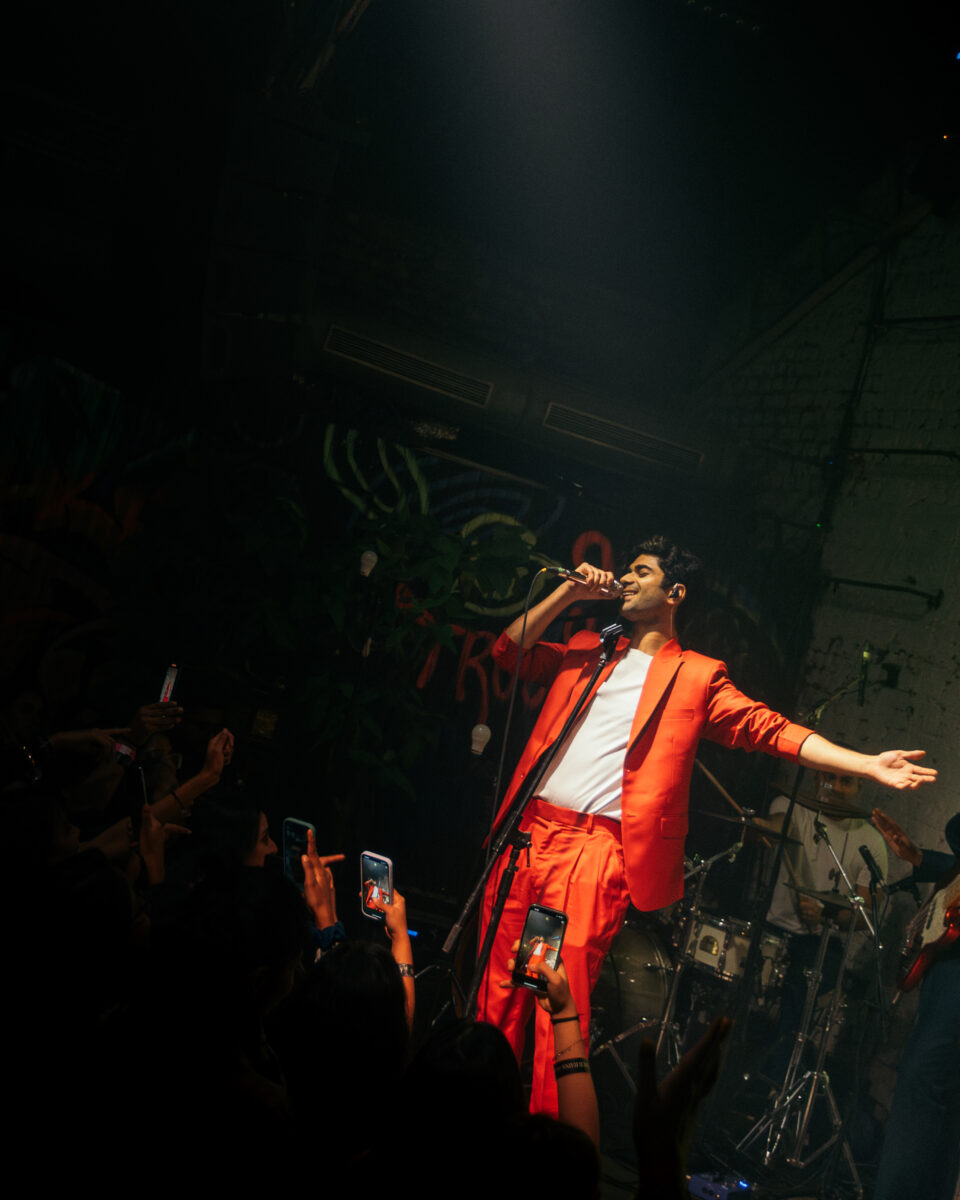
Mood over method: Taaruk doesn’t believe in set rules—he lets his music take shape however it wants to. “My music can come from anywhere it comes from, as long as it comes,” he admits in a deadpan tone. “Maybe one day we’re listening to some random beat. Maybe one day we’re just fiddling around with a guitar. Maybe one day I think of something really funny and witty and [decide], let’s make a song around this. But when it comes down to something emotional and irrational like art, you can’t really have a definite process.” So what does he do when faced with a creative block? “I sulk. I wait. I try listening to different things. It’s like heartbreak: you’re stuck in this one emotion and can’t find the words or the way to say it—until one day, it comes out.”
The future of music: Taaruk’s relationship with music is deeply intentional, and he hopes listeners will slow down enough to experience it that way, too. “I hope that the future of music kind of takes a slice from the history of music. I don’t see a lot of people listening to music as an activity anymore. There was a time when we used to exchange songs over Bluetooth—and the things we’d do for a song. Now, with the convergence of every piece of technology into one, it’s so easy to share music or discover something new. We were doing this when it was the hardest thing in the world, but that’s how far you’d go for a good song. [Music has] now almost become something you do while doing something else. I want it to get back to being something important.”

