



7 Easter Eggs From Our Conversations With Gorillaz About ‘The Mountain’
From langar at the Golden Temple and Ayurvedic retreats to how the idea of posthumous collaborators first came to them as early as 1999, here are the most fascinating insights from our conversation with Damon Albarn and Jamie Hewlett that didn’t make it into our Gorillaz cover story

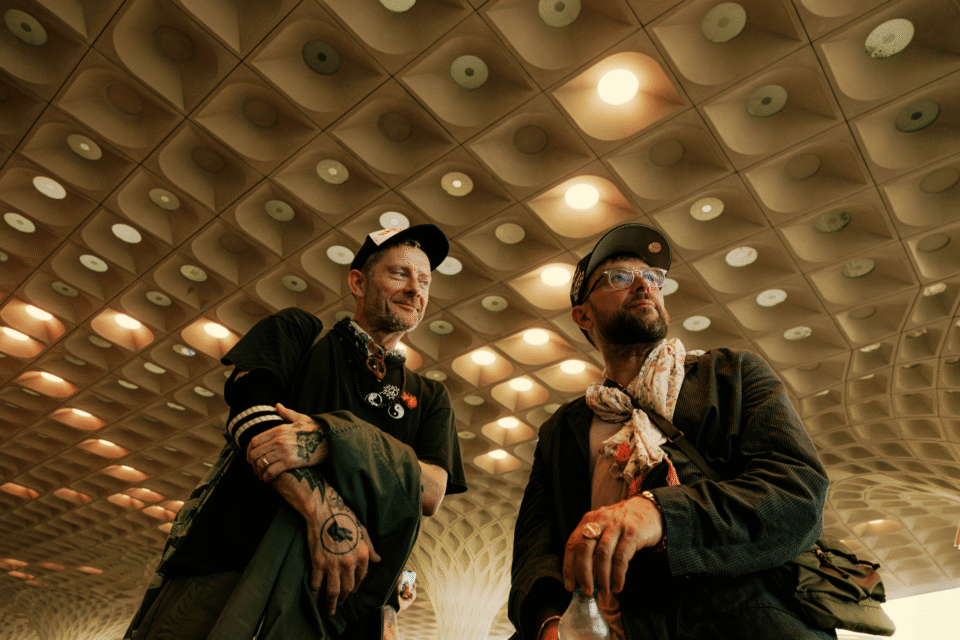
Gorillaz's Damon Albarn and Jamie Hewlett at Mumbai airport. Photo: Blair Brown
As Gorillaz’s new album The Mountain makes its way into the world and takes listeners on a trip like few others, there were years of experiences and decisions that led up to it.
From our January-February 2026 cover story, we learned about the losses that brought the virtual band’s creators Damon Albarn and Jamie Hewlett closer than they’d been in a while, and how India called out to them. While they spoke about working with the likes of singing legend Asha Bhosle, as well as recording and traveling through India, there were plenty of reflections, detours and deeper cuts discussed during our interviews that didn’t make it to the story.
Here’s a breakdown of everything we learned through our conversations with Albarn and Hewlett, and the unseen moments on their climb up The Mountain.
Pre-order the special print edition of our Reset Issue for more Gorillaz bonus content here.
1. Damon Albarn Visited the Golden Temple in Amritsar for Langar
Albarn, Hewlett, and the Gorillaz crew traveled across India both to seek inspiration and record, and Amritsar was one of those stops that served up the former. No trip to Amritsar is complete without visiting the Harmandir Sahib (Golden Temple), and Albarn recalls visiting the “communal food hall” for the open-to-all free meals. He told Rolling Stone India, “Just [seeing] the sense of charity and generosity and community… it’s very beautiful. It’s just wonderful. The kitchens are so inspiring as well. That is utopian, really. Simple, nutritious food available for everybody.”
2. Jamie Hewlett is a Fan of Ayurvedic Retreats
Prior to visiting India to make The Mountain, Jamie Hewlett told us he’d been to the country a few times before, including an Ayurvedic retreat in Kerala. He jokes about how he “felt 10 years younger” each time he came back home to Paris. Likening it to an “MOT [a rigorous health checkup] of the body,” Hewlett says he still does yoga every day and says he’s likely to be back for more. “I’ll do it again. I think I was told by the doctor, ‘If you come every 10 years, you’ll be fine.’ I’m due for a new one next year, maybe,” he says with a laugh.
3. The Gorillaz’s Idea For Posthumous Collaborations Has Existed Since 1999
The Mountain has been punctuated by several past collaborators appearing posthumously across tracks, from Dennis Hopper to Bobby Womack to Dave Jolicoeur from De La Soul and Tony Allen, among others. Albarn says that when he and Hewlett were creating the “manifesto” for Gorillaz as a virtual band with a lore in 1999, the idea was always there. “The character of Russel was always going to be able to call on dead musicians to sing through him. In a way, we’ve sort of realized one of our original ideas. And it works beautifully within the idea of reincarnation, which is, in a way, what The Mountain is about,” Albarn says.
4. There’s A Reason Black Thought Appears Prominently Throughout The Album
The Roots MC Black Thought is a firebrand on stage and in the booth, and several decades of material already proves that. On The Mountain, he teamed up with Gorillaz for three songs – “The Moon Cave,” “The Empty Dream Machine” and “The Sad God” – which arrive at key thematic moments of the concept album. Dipping into philosophy, referencing Asha Bhosle singing “Dum Maro Dum” and Lord Krishna, there’s a whole range of bars from Black Thought. Albarn calls him a “cultured guy” when asked about his choice of lyrics. He adds, “He [Black Thought] was the perfect guy to sort of take the role of a kind of loose narrator on the album. He sort of says all the things that I missed out, in a way. I was in quite a serious mood, but I like his playfulness.”
5. Albarn And Hewlett Are Best Friends
Although we had two separate conversations with Albarn and Hewlett about The Mountain, they were exactly on the same page about their experiences and thoughts on the journey they undertook for the album. While they both admitted that they had creatively “drifted apart” at some point, Hewlett emphasized that they are the best of friends. “Damon’s daughter and my youngest son are almost exactly the same age… they’re six months apart, and they still hang out together,” Hewlett says.From holidaying together to traveling around the world for many projects, Hewlett recounts going to China for their opera show titled Monkey: Journey to the West between 2004 and 2007. “We’ve almost been arrested together. We’ve also fell out in the same way. It’s quite an intense relationship and when you’re very close to somebody, if there’s something you disagree upon, it can get out of control a bit. We’ve had some big fights… we’ve also had physical fights. There is that kind of relationship. I love him dearly. He’s my brother. But also sometimes I fucking hate him. Sometimes he hates me, but then ultimately, we love each other. But this one, this trip to India was really a moment where we came back together,” Hewlett recalls.

6. Hewlett Wanted to be Mindful of What Kind of Indian Motifs to Draw From
The brains behind the visuals of Gorillaz, Hewlett has noted in interviews how India would no doubt inspire any artist worth their salt, given our vast and varied art styles. He was particularly keen on Indian mythological artwork, but said he had a “lot of conversations with people” when he was in the country to ensure “not to offend” any sensibilities. While in Mumbai, Albarn got a tattoo of one of the visual motifs of The Mountain – an outline of a mountain with Parvat written in the Devnagari script. Hewlett says, “We always get tattoos when we go places as a kind of memory.” They spoke to the group of tattooists, whom Hewlett considered “very hip and cool.” On asking them questions about how the tattoo artists work with Indian religious symbols, one of them told Hewlett how he got “into a lot of trouble” for drawing Lord Shiva. “He said, ‘Just stay true to the image. Don’t, for example, give Shiva a guitar,” Hewlett recalls.
7. The Best Way to Experience The Mountain is to Immerse Yourself In It
A testament to the hand-drawn illustrations in their short film, Gorillaz hope that The Mountain and its message come through when their fans are fully immersed in the audio-visual experience. Released via their own label Kong, Hewlett encourages people to “escape into the sonic, visual meditation” that The Mountain puts forward “about a subject that applies to all of us.” He adds, “The album comes with a book with all of the artwork. Watch the video, put the album on. Do turn off your telephone, sit in a comfy chair, look at the book, and just listen. And you go on a journey, and at the end, hopefully you’ll feel nice. That’s what we can offer.”