


Gulzar Looks Back on The Lyrical Legacy of Indian Cinema
From Raj Kapoor to A.R. Rahman, Gulzaar unpacks how the language of Indian film music has mirrored its people, politics, and poetry.

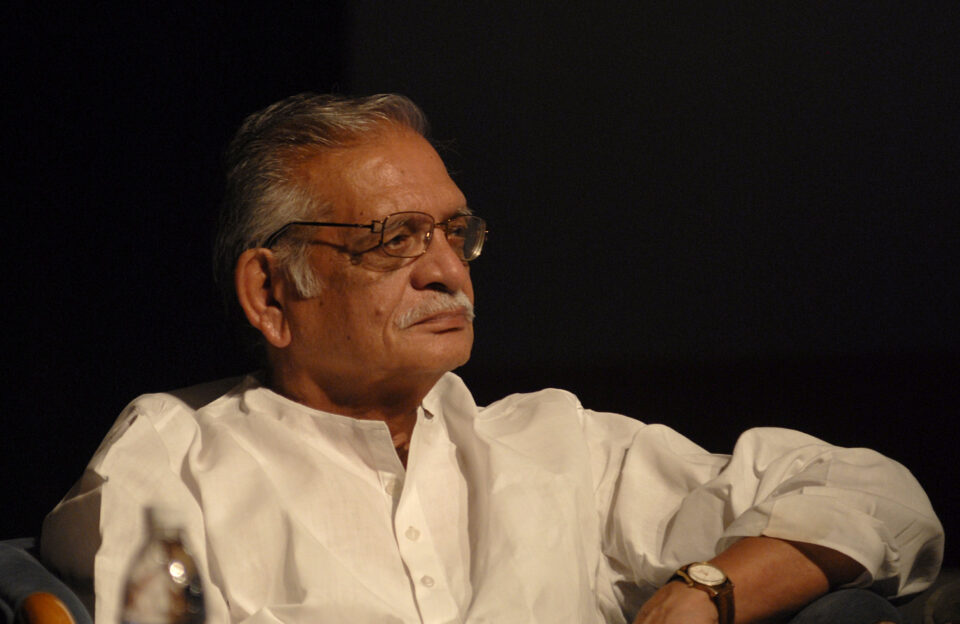
Photo by Prodip Guha/Getty Images
In early October, stalwarts from the film and music industry gathered at Whistling Woods Institute for a film festival format titled Celebrating Poetry & Music in Indian Cinema. The event paid homage to legends like Raj Kapoor and Guru Dutt while inaugurating the country’s first-ever Indian poetry appreciation course. The auditorium reverberated with the soft hums of “Aap Ki Aankhon Mai Kuch” & “Phir Wohi Raat Hai Khwab Ki.” It was an evening meant to spotlight the poets behind the prose, the often unsung yet essential lyricists of Indian cinema.
The evening’s emotional crescendo arrived with Gulzar, whose pen has shaped generations of songwriting. Often referred to as the original “tortured poet,” the poet and lyricist entered in his signature all-white ensemble, garnering an outpour of applause. Pensively, he gazed at the audience, seemingly puzzled by his own living legacy. In a panel comprising Founder Subhash Ghai, lyricist Kausar Munir, filmmaker, costume designer, and playwright Salim Arif, and Gulzar himself, moderated by Munir, a G20 Woman Achiever in Media 2023 awardee known for her work in Bajrangi Bhaijaan and Hasee Toh Phasee, the group discussed the foundational role of the lyricist in shaping the canvas of Indian cinema.
Ghai acknowledged how the timeless work of legends like Shailendra and Gulzar, who penned multiple songs performed by Raj Kapoor and Guru Dutt, still resonates with both young and old audiences. A classic case is when Raj Kapoor’s “Mera Joota Hai Japani” got referenced by modern-day rapper KR$NA. He cheekily quipped how Gen Z, even with the rise of AI and modern technology, is heading towards the old-school road less taken — even reciting Gulzar’s poetry on social media.
The event began with an audio-visual presentation, prepared by Arif and the students, which showed the contrasting discographies in Kapoor & Dutt’s works. While songs, like “Mera Joota Hai Japani,” highlighted the common man’s capitalistic purgatory through humor, melancholic tracks like “Yeh Duniya Agar Mil Bhi Jaaye” underpinned the struggles of social disenfranchisement. Both filmmakers, though cut from the same cultural fabric, contrastingly portrayed distinct socio-economic influences — what Gulzar described as their “Haal, Haalat, Abai & Ilaqai” (socio-economic conditions and influences).
One, an extroverted and jolly Pathaan, the other a demure Konkani man. Yet, both vocally romanticized the struggles of their generation. Even a stalwart like Gulzar sat humbled in the virtual presence of these cinematic giants.
After the AVs chronicling Kapoor and Dutt’s centenary legacies, Munir opened up about feeling insecure amidst such greatness on stage. “But I represent the audience,” she said firmly, “and I recognize that privilege.”
The conversation soon steered to how deeply poetry and music are embedded in Indian cinema. Munir observed how actors utilized lyrics, or geet, music, and poetry in their filmography. She pointed out how Indian cinema “sings,” which is our biggest arsenal. Opening the floor for discussion, the panelists began dissecting the magnanimity that lay in front of them.
Cinema, Gulzar said, is “as vast as the Mahabharata; it unravels in front of you.” In his comforting cadence, the veteran poet-director added, “Shayari, or poetry, in cinema comes from studying life itself. Cinema is an expansive, immortal being; both life and it hold hands together.”
Bit by bit, he illuminated how it is interwoven, socio-cultural commentary. “Through generations, music was passed along as oral tradition, and experiences started collating. Rhymes were remembered this way.”
When asked what comes first, the lyric or the melody, Ghai mentioned how lyrics prod people to remember songs, and hence take precedence. Sharing an anecdote from his days on the sets of Khalnayak, he emphasized how an entire shot sequence was changed to suit the lyrical tonality accordingly.
Meanwhile, Gulzar had a slow-burning rebuttal. It is interesting to note that he was initially a purist. Directing and songwriting did not entice him as much as just writing did. He’d often stamp his name on random books to savor the momentary feeling of being an author. His stint in films and composing was a series of fortunate accidents through his sojourn in an outhouse with other writers. Through word of mouth, he landed on the sets of Bandini, unknowingly setting the stage for his lyricist debut.
He recounted, with humor and precise mimicry, how legends like Bimal Roy and S.D. Burman gave him a ridiculously onomatopoeic melody, or “dummy bhol,” for his first song written for Bollywood cinema, “Mora Gora Ang Laile.” Amid a playful debate over whether the song should be set indoors or outdoors, Gulzar observed that ruthai (creative conflict)is a part and parcel of greatness in the making.
“The Dhun always comes first. Songs are remembered by them. Aadhi yaad, phir bhi gungunayi hui (even if half-baked, you’re still humming the tune),” he theorized.
He also tied it back to silent films, which had folk tradition infused in every core of the production. Village munshis (an official clerk) would craft the dhun, with captivating mukhdas and antaras that encapsulated the rural essence. Ironically enough, they also drew in loud audiences, who’d audibly score the film through their reactions. This cemented how the melody remains the beating heart of Indian cinema.
“Everyone sings in India. From the Kulfi walas, Chakki-wielding workers, and mothers with their soothing lullabies,” he pointed out, explaining how the epicenter of Indian media rests on its sonic foundations — one laid by its rural, folk, and indigenous population.
The lyrical maestro also mentioned how lyrics were a reflection of the societal setup. Hidden in harmless, palliative lyrics were harsh truths. Referring to Shailendra, whom he considered one of the greats, he added how the writer politicized his verses, which were never visible on the surface. A dedicated trade unionist and communist, Shailendra would often write about feudal atrocities and dogmatic ideals that persisted in his surroundings. Songs became a medium of rebellion, one that would echo sonorously for generations to come. For example, in the song “Mera Joota hai Japani,” the poet wrote “Honge Raaje Raajkunwar// Ham Bigde Dil Shehzaade.” This alluded to the common man celebrating his free-spirited nature amidst the people from the upper echelons.
Similarly, Gulzar revisited his own song “Beedi.” Pointing out its subtext, he shed light on how lyrics such as “Ja Padosi Ke Chule Se Aag Leyle” spoke of the working class reclaiming what was taken away by exploitative colonizers.
For him, songwriting should fit the character’s inner workings, like how a hand fits a glove. “A gun-wielding villain would not sing about melancholy,” he remarked. “In cinema, zabaan dialogue ke saath chalni chahiye (the singing has to match the dialogue). Nothing comes from us; everything is borrowed from culture, or ‘udharna.’ You must blend language in such a way that it evolves with time,” he added.
In the same capacity, Arif pointed out the death of Indian indigenous storytelling formats due to the globalization of international OTT structures. He linked it to the cultural osmosis of cinematic realism from Europe and Latin America, which slowly eroded the grandiose visual and social Indian styles from the Fifties and Sixties. “Back then, songs were not made for musical pauses. Even trailers had different tracks,” he reflected. “The negation of popular Indian cinema has likened it to trash. Cinema schools are also to blame for this. In the name of global identity, we are dumping down our own traditions, opting for easier methods that ‘sell’ an idea.”
With today’s trend of reducing songs to two-minute palatable Instagrammable anthems, the space to convey, express, and evoke has become constrictive, even claustrophobic. To this, Gulzar calmly responded: “There arise situations which give musical inklings. Humein humari zameen choti nai karni chahiye” (we shouldn’t shrink our worth to make ourselves seen). Back when I was making ‘Mera Kuch Saaman’, Pancham Da thought it was a movie scene.” Composing prose and verses devoid of rhyme schemes with a harmonium underscoring their collaboration, Gulzar spotlighted how that iconic song was composed in a single sitting. It was not born out of efficiency, but the very excessiveness that Indian cinema shies away from today.
As the session drew to a close, he urged aspiring youngsters to break the mold of experimentation, praising artists like A.R. Rahman, who popularized Indian music internationally, so much so that the world yearns for our culturally rich tunes.
In parting, the panelists shared a few pearls of wisdom that are bound to linger in the mind of every quill-wielding romantic. “Don’t start learning poetry from film songs. You’re commissioned to place yourself between characters. Writing a film song and poetry are two different things,” Gulzar advised. Arif, following it up, added, “You can only write lyrics if you know poetry.”
Lastly, Ghai tied it all up, ending it with “Baat gehri hai, iske liye to Gulzar Hai” (for intense conversations, there’s always Gulzar).