

Jivraj Singh Is Making Music You Have to Learn How to Hear
In the years since Parekh & Singh, Jivraj Singh has moved away from songs towards sound, improvisation and the discipline of deep listening

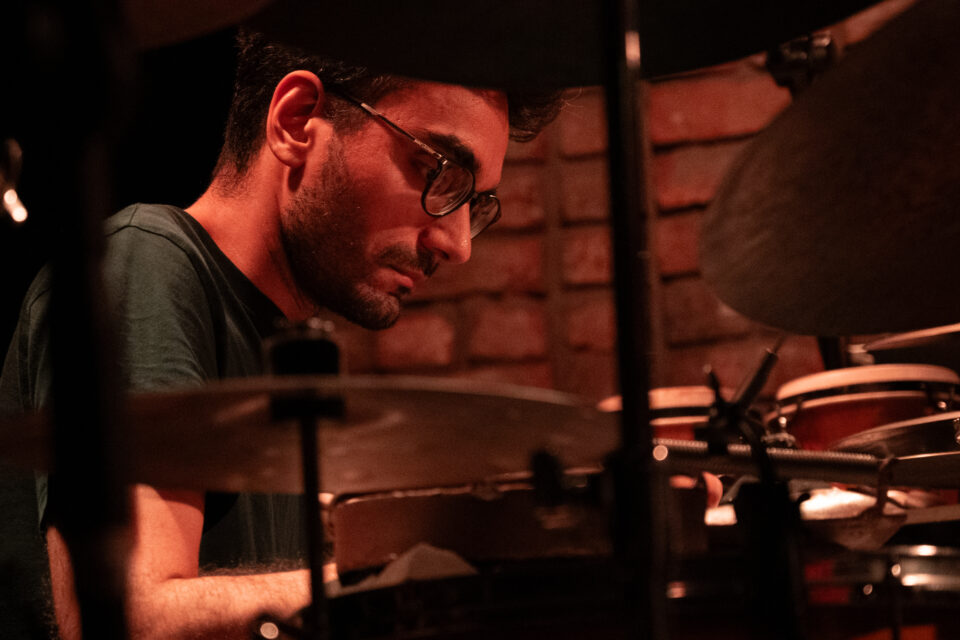
Kolkata-based artist Jivraj Singh. Photo: Margub Ali
His glistening eyes reflect intent and conviction. His smile is heartfelt when he hears something he likes. Invariably reticent at the start of a conversation, his sonic world opens up to you gradually, one note at a time. Ultimately, though, it reveals itself, like in the fullness of a major chord, echoing thought, emotion and purpose.
It’s clear Jivraj Singh, one half of the now-defunct dream-pop duo Parekh & Singh, is now leading a quiet but busy life pursuing a different calling. He’s seeking fulfilment in a kind of music that seeks to break barriers, both for the performer and listener; music that is born out of rejecting and re-inventing forms, dismantling and recalibrating genre conventions to give birth to a music that is richer, complex and uniquely multi-dimensional.
“I have generally been more interested in music where the pulse is complex, isn’t stated very obviously, or is seemingly suspended entirely – music which gives me more agency,” Singh tells me at his home studio, set up with sundry recording equipment and a wide array of percussive delights, like rattles, shakers, wood and ceramic cowbells and what not. There’s a drum kit too. All these and more were in full bloom at one of his gigs early this year in Kolkata. Inky Ping, featuring Jivraj and producer Varun Kishore, was billed as a presentation of “experimental improvisation” wherein the audience was treated to a shape-shifting symphony, a guitar and piano adding to the mix which also included recorded sounds of crickets chirping and Jivraj actually crushing paper and pouring water on stage.

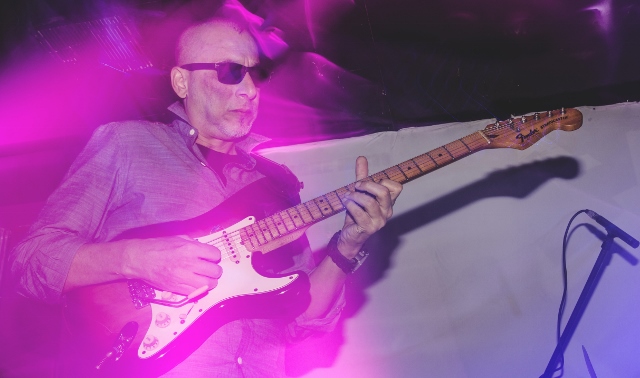
More recently, Jivraj reframed the contours of experimentation by collaborating with Amyt Datta (guitar) and Mainak ‘Bumpy’ Nagchowdhury (upright bass) for a concert titled Streams and Branches on Sept. 6, 2025 at Skinny Mo’s Jazz Club. Relying only on sparse “wispy motifs” and the “overall sound world” of some of the guitar guru’s compositions, the trio created a fresh musical experience dedicated to the memory of mentors Gyan Singh, Monojit ‘Kochu’ Datta and John Cage, their birth anniversaries coinciding in September.
If reading Cage has helped shape Jivraj’s thinking on music and beyond, parents Gyan and Jayashree played a significant role in his musical upbringing. While they were on tour, little Jivraj would often fall asleep on stage behind the drums. “I do have a fond memory of Nondon Bagchi (big daddy of drums from rock band High) putting one stick in his mouth and playing with his right hand while holding on to me with his left, so that I wouldn’t fall off my chair at 2 am,” he recalls. Over time, Jivraj was old enough to earn the seat behind the kit, playing in Gyan and Jayashree’s band, Skinny Alley, with both Amyt and his brother Kochu as bandmates. “All four of these people were integrally spiritual, and I feel extremely fortunate to have had access to that dimension, first-hand with the three whom I encountered in person, and through the wealth of material that surrounds the fourth (Cage).”
Streams and Branches was special and deeply personal, a definite pointer to Jivraj’s universe of music-making. Centered on the calmness of body and mind, the focus is on being attentive and receptive to the moment. “It’s an incredibly delicate state, one that I reckon most musicians neglect. Because this mode is so gossamer-like, it can only come from regular practice.” Hence, in the run-up to their memorial concert, Jivraj, Amyt and Mainak did commit to a week’s rehearsal to encounter this state of awareness. “We played our instruments individually and together. We listened to records, looked at scores, texts, photographs, paintings and graphics; had conversations, drank tea and sat in silence (not enough). Eventually, we began to come into a shared space – emotional, intellectual, physical,” Jivraj reveals.
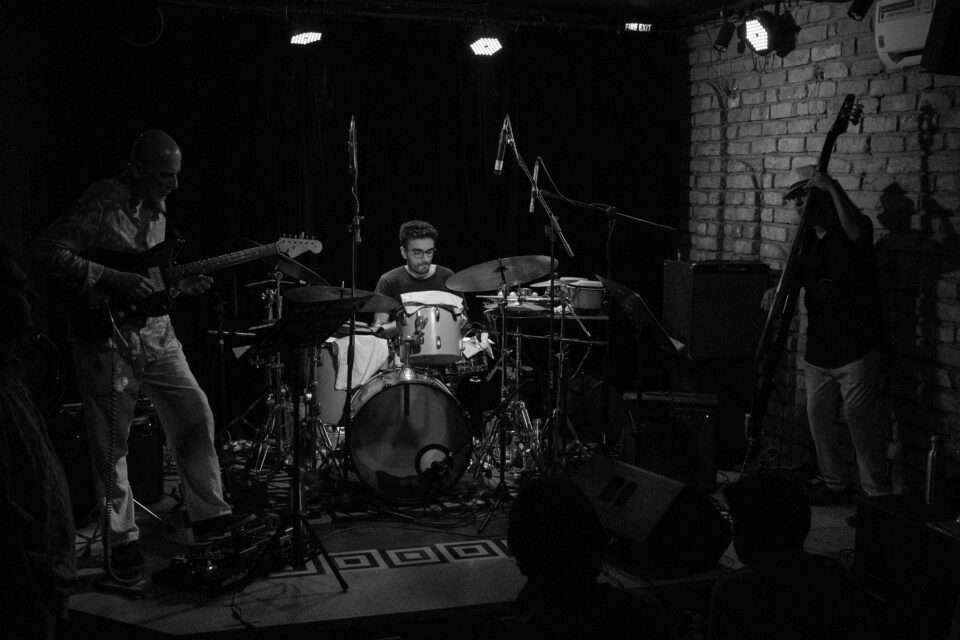
Since the idea was to break new ground with Amyt’s compositions (“Ironic Bironic,” “Corridors,” D –For Brother (1992) tunes “Neelima,” “Village X”), rehearsals were held within “four fields of forces,” explains Jivraj. First, the band members and their individual circumstances: Mainak, playing upright bass, had to shed many of his innovations associated with years of playing the electric bass while Amyt had to deal with a set of unique challenges associated with the experimental tuning system he was using. The second field was Amyt’s compositions and understanding their emotional undertones. A large part of the rehearsals was like “controlled collisions” between Amyt’s compositional field and Jivraj’s studies of various musical aspects, both micro and macro. The final field was the outer world, the venue, audience, promotions, logistics. “Ideally, we try to bring the tension of the concert to the rehearsal, and the relaxation of the rehearsal to the concert,” notes Jivraj, alluding to the stated objective of experimental art — the collaborative participation of performer/composer and listener/observer.
On gig day, the music was richly vibrant. Frenetic energy gave way to unbridled joy. Deep introspection led to moments of melancholy and silence. The textured improvisation allowed the imagination of colors too; from raging red to bemused blue, Streams and Branches was a multidimensional exposition of ideas and sounds. There was, admittedly, a large overlap with jazz but the intention was to destabilize and critique the idea of genre and not play by the rules. Not that it works all the time, admits Jivraj, as one is always falling into some habit or pre-conceived way of doing. “However, just to have this dialectic alive in the experience is productive in a radical way.”
At the core of Jivraj’s experimental endeavours, therefore, is an acceptance of the notion that the listening activity itself needs to be cultivated, a concept espoused by Cage and other musician-thinkers like Christian Wolff, James Tenney, Pauline Oliveros, Alvin Lucier or Karlheinz Stockhausen. So, how does one listen to what is not typically considered music? Jivraj explains with a question. While listening to a recording or a performance, do we account for the sound of the air-conditioning in the room, the tinkle of cutlery from the kitchen or a neighbour’s cough? If we do, it opens up many more aspects for aesthetic appreciation. “Taking note of their possible relationships in terms of time, space and texture is very helpful.” For Streams and Branches, unbeknownst to the rest of the gathering, auxiliary sound sources were planted with four members of the audience. The reality is, as Jivraj notes, the “activity of listening” doesn’t require too much effort in most familiar musical contexts. “A music that is experimental will encourage all listeners involved to (re)activate their auditory apparatus,” he says.

This form of listening can only happen with practice. The idea is to develop the ability to step back and take non-judgmental views of things to widen the periphery of imagination. Jivraj is getting there, dipping into it at least a few times a day. It’s also his coping mechanism. “I use it to deal with the spectrum of reactions, from annoyance to suffering, that is triggered by the auditory chaos of living in urban India,” he says, his eyes glistening with a hint of a smile. Essentially, for Jivraj, everything we do can be music. But only if we listen musically.
(This article is based on face-to-face and email conversations held over a few months after the Streams and Branches concert in Calcutta on Sept. 6, 2025)
Rolling Stone India: What do these musicians mean to you?
Jivraj Singh: Gyan seemed to truly embody the admittedly difficult ideal of not having an ego, while also being able to hold his ground with quiet strength. It was a remarkable balance, and I have only recently begun to understand and appreciate this ability of his. He was also very keen about helping other musicians, giving advice on equipment purchase and repair, etc. A large number of musicians have benefitted from his (and Jayashree’s) kindness… And we continue to do so.
And Monojit ‘Kochu’ Datta?
Monojit and I played pop and dance gigs together in Skinny Alley. I hadn’t really woken up to the idea of ‘percussion’ at that point – I was still thinking of drum-set and percussion as separate categories. So perhaps I wasn’t in my most receptive mode… (But) playing together was very educational and enjoyable.
Anything specific you can remember?
One time, I think I had just said something along the lines of, ‘I don’t do any hand drumming.’ In response, Monojit said, ‘all drumming is hand drumming.’ Also, he wouldn’t practice anything fancy. Instead, he would spend hours working on seemingly simple foundations. No doubt he was operating at some sublimely deep levels.
Amyt Datta told me that at times he feels you know his music better than himself.
Amyt is incredibly generous in the way he opens up his music to me. He’s the person I’ve spent most musical time with, and he is definitely my primary musical influence. Many aspects of the way I approach the drum-set are derived from his guitar playing. At this point, we share a common musical language – particularly of rhythm and texture – at a very deep level.
And John Cage?
He’s been a source of knowledge, encouragement, humour… something of a constant companion since 2021. I was undeniably pleased to discover that he shared a birthday (September 5) with Gyan. I’ve read many of his lectures, essays, letters and textual experiments. Also, his scores are very mind-expanding – to play from, of course, but even just to look at for their graphic qualities.
Shantanu Datta is a Kolkata-based journalist. He is the author of Calling Elvis: Conversations With Some of Music’s Greatest (Publisher: Speaking Tiger)