From Bhutanese dawn meditations to a Colombian beatmaker making impromptu songs with Rajasthani folk musicians, this year’s festival was a thought-provoking celebration of how heritage can still sound revolutionary
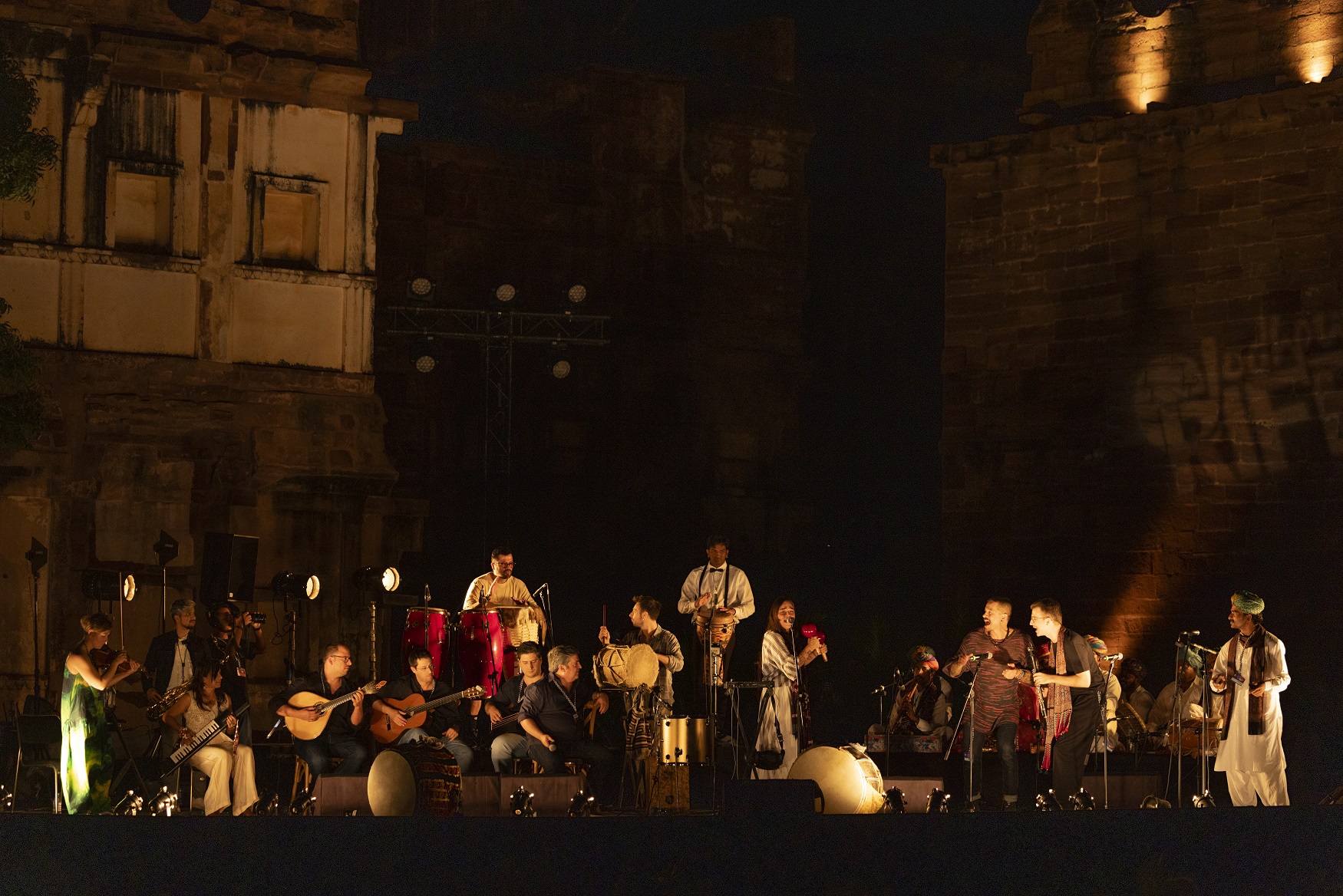
At the legendary RIFF Rustle, over 30 musciains from around the globe came together for a power-packed jam that blurred borders and languages. All photos courtesy of Jodhpur RIFF
It’s 5 AM in Jodhpur, and the towering Mehrangarh Fort that usually watches over the city is still shrouded in darkness when we arrive at the Jaswant Thada terrace nearby. To the left, the call to prayer from a mosque reverberates through the air. To the right, the faint ringing of temple bells gradually grows louder. Somewhere between these sounds, the delicate twang of Sonam Dorji’s Drangyen, a Bhutanese lute, floats with the dawn birdsong — ushering in a deeply meditative state as the first gentle strokes of sunlight pierce the sky. The Bhutanese vocalist, multi-instrumentalist, composer, and archivist is presenting YakVibe — a folk music experience carrying the spiritual sounds and stories of the Himalayan highlands — at the Jodhpur RIFF dawn session, a sensorial early morning experience that has become one of the festival’s most defining curations.
It’s a moment emblematic of RIFF’s remarkable knack to bring together sounds that rarely belong in the same breath, yet somehow greet each other with a smile.
At a time when the international festival circuit is eyeing India, the Jodhpur RIFF (Rajasthan International Folk Festival), now in its 18th edition, is an independent genre-blurring festival with a reputation for uniting some of the most distinctive voices in folk music from around the world. Under the patronage of the likes of Jodhpur’s Maharaja Gaj Singh II and Mick Jagger, it has become a space for collaboration, cultural exchange, and undiluted discovery. Helmed by the festival’s director and producer, Divya Bhatia — who traverses the globe in search of hidden gems in the roots music landscape — a 15th-century fort becomes a portal to some of the most forward-thinking sounds and musicians of today.
With a relentless schedule of music performances, knowledge-sharing sessions, and unexpected pairings running from 5 AM to 3 AM, the festival is effectively an agility test. Much to everyone’s disappointment, it was forced to cancel its evening programming on the second day after an unseasonal thunderstorm left the courtyard mainstage temporarily out of commission. Yet it bounced back with vigor, cramming most of Day 2’s artists into an already jam-packed schedule the following day.
That evening, the festival was graced by the likes of Padma Shri awardee Lakha Khan Manganiyar and Barkat Khan Chattangarh, torchbearers of Rajasthan’s Manganiyar legacy, kamaicha virtuosos Ghewar Khan, Feroze Khan, and Darre Khan, Portugal’s fado masters Helder Moutinho and Ricardo Parreira, and Chennai’s Jatayu, who brought an edgy blend of Carnatic, jazz, and rock to the stage.
One of the night’s standout performances came from Polish trio Karolina Cicha and Company. Playing the accordion with one hand, hitting piano keys with the other, and stomping her feet on a drum, all while singing, lead vocalist Cicha commanded the stage with pieces steeped in a don’t-surrender spirit that paid tribute to Poland’s multicultural fabric — from dedications of strength to Ukrainian refugees to happy songs about family life made for Lithuanian minorities.
This was followed by a mesmerising medley that perhaps best captures the festival’s longstanding commitment to bridge boundaries through music — The Cool Desert Project, an initiative born out of Jodhpur RIFF in 2023 that reinvents Rajasthani folk classics through a jazz lens. Comprising the SAZ trio of Sadiq, Asin, and Zakir Khan — young folk masters from Rajasthan’s Langa community, known for their subversive sound — along with Sax on Toast, the moniker adopted by saxophonist Rhys Sebastian of Bombay Brass and The Bartender acclaim, the collaboration swept us away into a mind-bending dialogue between oral tradition and urban groove. Performing a mix of original compositions like “Sundar Gori” and “Neemdi” along with electrifying renditions of “Kesariya Balam” and “Hitchki,” the sounds of the khartal, sarangi, and saxophone danced together with reckless joy. Elevated by Merlyn D’Souza’s deft touch on the keys and Amandeep Bhupinder’s textured guitar lines, it was a performance that throbbed with an improvisational energy and the enduring musicality of Rajasthan’s folk tradition.
Speaking to Rolling Stone India right after the performance, Sebastian admits they only managed to do one practice run before the show. The rest, he explains, was simply about tuning into each other’s cues and trusting their instincts. “The crucial thing about this set was just to really listen to each other,” he says. “Everyone’s just kind of directing the song as they feel, and it’s also about the others letting that happen. We hold a safe space for each other to take charge, but also to follow each other.”
He adds that while past Cool Desert Project shows featured a full drum section, this time they skipped it entirely, letting Sadiq and Zakir drive the rhythm with just their dholak and khartal. For their part, SAZ are finding their footing as both guardians and innovators. “We perform songs that have been passed down to us from generations before, but we are also trying to create new music that we can pass on to the next set of generations,” says Asin Khan. This ethos was on full display at the festival, where the trio joined forces with Kathak dancer Tarini Tripathi for Inayat: A Duet of Four, and shared the stage with Syrian-Swiss saxophonist and improviser Basel Rajoub.
Around midnight, the gleaming full moon guided us to the fort’s ancient Salim Kot area for Club Mehran, a festival mainstay that pulses with after-hours intimacy. London-based Chilean-Italian Latin jazz singer Rosa Cecilia, who first performed in India at the IIMW conference earlier this year, set the tone for the night with her wistful charm and wink-laden humor, while Italian folk ensemble Ars Nova Napoli cranked the energy all the way up with their frenetic violin flourishes and accordion melodies.
But the real showstopper of the night was Killabeatmaker, the alter ego of Colombian DJ, producer, and beatboxer Hilder Brando. Accompanied by Guadalupe Giraldo on tambora, gaita, and vocals, and Julian Herrera on percussion and choir, Killabeatmaker tore through a beautifully chaotic set, mixing ancestral voices, African rhythms, and Andean traditions into a powerhouse performance punctuated by piercing yowls, spontaneous beatboxing, and high-frequency beats. In one of the more heartwarming moments, the Killabeatmaker crew was joined on stage by Rajasthani dhol drummers and folk musicians from the Manganiyar community, who improvised a song about unity on the spot.
“In the beginning, I was worried, because it’s really different [forms of music],” Brando says to me over lunch the next day. “But when we came together, they had the most beautiful energy. It was like a connection of souls.” As he tucks into a hearty chicken curry, he can’t help but draw parallels between India and Medellin — food and otherwise. “India and Colombia are both disorganized but also organized at the same time,” he says with a laugh. “In Colombia, we are very mixed between the African Diaspora, our indigenous communities, and white people, and you can see this mix in our music too.”
Perhaps it was this vision and openness to cross-cultural collaboration that earned Brando the title of this year’s Rustler — the conductor who leads the festival’s revolutionary RIFF Rustle format, where nearly every artist on the lineup comes together for a jaw-dropping, genre-defying jam. Watching the Rustle in action is an experience that’s hard to describe as anything other than spellbinding. This year, 36 artists from across 7 countries got together on stage for a crossover episode that pushed every boundary to its brink. Finnish violinist Emilia Lajunen’s five-string fiddle ricocheted off Merlyn D’souza’s keytar, sparking a raucous instrumental conversation. Tenerife-based gypsy jazz band Nicotine Swing’s sax player, Kepa Martinez, exchanged knowing smiles with Sebastian, while Karolina Cicha’s soaring tenor crashed straight into Damani singer Anita Dangi’s powerful vocal range. It was a dizzying collision course that cut across languages, instruments, and even time.
At Jodhpur RIFF, this spirit of curious collaborations becomes one of warm friendship. From the glimmering serenity of Padma Shree awardee Pandit Satish Vyas’s santoor, intertwining with Paras Nath’s flute and Mukund Deo’s tabla under the rising moon, to a dialogue on preserving indigenous sounds helmed by Kazakh virtuoso Layla, Uzbek vocalist Gulzoda Khudoynazarova, arts promoter Zhan Kasteyev, and cultural scholar Husniddin Ato on a sticky afternoon — it flows through every note and conversation.
And as the fort’s glowing ramparts gave way to the first light of a dawn aarti at Jaswant Thada, it was a reminder that here, diversity becomes rhythm, tradition becomes improvisation, and the stage becomes a universe of possibility.
The songwriter and performer broke through with early Sixties hits like "Breaking Up Is Hard…
The hip-hop star has extended his 'global mystery mandate' to the upcoming New Delhi show,…
In the eight-minute animated short soundtracked to “The Mountain,” “The Moon Cave,” and “The Sad…
Blackpink is trading the neon pink for a sci-fi aesthetic that catapults the bar for…
The group also shared a dynamic music video for their anthemic song "Go"
Fresh off an electric set at Royal Stag Boombox in Kolkata, the band discuss the…



