

Your Relationship Isn’t a K-Drama Romance Arc, and That’s Okay
When fictional plots and characters set the benchmark for relationships, reality can feel underwhelming. But love without dramatic turns and picture-perfect trips might actually be closer to the kind that lasts.

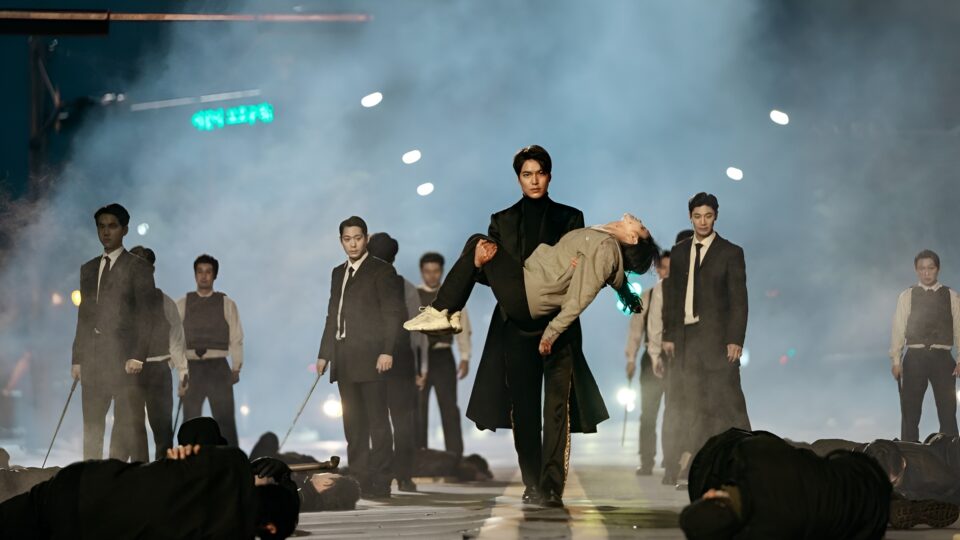
Lee Min-ho and Kim Go-eun in a scene from 'The King: The Eternal Monarch.' Photo: SBS, courtesy of Han Cinema.
Ever since we started watching K-dramas, there’s been a slow but steady shift in how we see romance. So, if you’re feeling like your local florist or those heart-shaped boxes just aren’t cutting it this year, you’re likely experiencing a side effect of the K-Drama craze. For many K-drama fans, Valentine’s Day is about matching the dreamy perfection of a drama, swapping the crazy reality of dating apps for slow-motion gazes and heartfelt confession moments. And while there’s no denying that these shows are an epic unwind, they’ve also low-key convinced us that we deserve a main character moment and made us question why our lives lack the epic background score and the permanent soft-glow filter.
What’s likely changed the most is what we now call “boyfriend goals.” We are no longer in the “bad boy” phase; now we are in the era of emotionally intelligent men. Think of Ri Jeong-hyeok (Hyun Bin) from Crash Landing on You (2019), for example. He isn’t just the tough captain in the Korean People’s Army; he’s the guy who learns how to brew coffee from scratch because his partner missed it, or who ties her shoelaces in the middle of a crowded street. When we see characters like Hwang Yong-sik (Kang Ha-neul) in When the Camellia Blooms (2019) be unapologetically loud about his feelings, it makes the standard “Love You” text from a real-life partner feel a bit, well, lazy, because deep down we’re starting to crave that “soft masculinity” where a man is emotionally intelligent, caring, and isn’t afraid to be vulnerable. Shrijita Roy, an avid K-drama lover, says, “I’ve been conditioned by K-dramas to expect a certain level of emotional maturity from my partner. Sorry, not sorry, I’ll just keep dreaming.” It’s a classic case of expectation versus reality, leaving us caught between the comfort of a scripted romance and the messy, unedited truth of real-life love. After all, it’s hard for a real-life partner to compete with a man who was literally written to be perfect.
But let’s be honest: K-dramas are also the best way to get over the exhaustion of today’s “hookup culture.” These days, dating is a never-ending cycle of ghosting and “situationships.” In K-dramas, though, we get the glorious slow-burning romance. In the 2022 superhit Business Proposal, the romantic tension between Kang Tae-moo (Ahn Hyo-seop) and Shin Ha-ri (Kim Sejeong) builds over tiny, candid everyday moments — a short glance, a shared umbrella, a worried phone call, or a protective hand over a head during a car ride. Maybe that’s why this Valentine’s Day, a lot of us are realizing that, even though speed dating is in, what we really want is courtship. Seulgi, a PR professional from Seoul, shares that Korean men are nothing like the K-drama heroes. “People hardly have time for each other,” she points out. “Dating in Korea, like in most cultures, means dealing with everyday life, work stress, and family issues. In fact, many are either speed dating or not dating at all due to the high cost of living and the stressful work culture.” According to a report from NDTV World, the South Korean government is holding speed dating events to boost marriage rates. There are also trendy new “date courses” that let people go on a lot of mini-dates in one outing to save time. “I’d still take the nerves and the ‘what-ifs’ any day,” Seulgi says adding, “I’d love the build-up and genuine emotional risks that make the first time of holding hands feel like a sudden spark.”
And while we yearn for that genuine emotional connection, K-dramas often make sure that the “spark” unfolds in the most glamorous settings imaginable, partly because they play into the rich CEO trope. Whether it’s the Shinhwa group heir Gu Jun-pyo (Lee Min-ho) from Boys Over Flowers (2009) whisking Geum Jan-di (Koo Hye-sun) away on exclusive trips or King Lee Gon (Lee Min-ho) in The King: Eternal Monarch (2020) literally crossing parallel universes to find his girl, K-dramas suggest that love is best served with a side of grandeur. Sometimes, it’s hard to stay happy with your typical daily routine when you’ve been watching characters fly to Jeju Island on a whim. It creates a weird Valentine’s paradox: we crave the emotional intimacy, but we also wouldn’t mind the elegance that usually ties it all together. It makes our real-life celebrations feel a bit low-res compared to the 4K cinematic romance we see on screen, where even a simple “I love you” comes with a fireworks display.
At the end of the day, the best way to handle a “Hallyu-tinted” Valentine’s Day is to use these shows as a mood board, not a rulebook. We can appreciate the way Lim Ju-kyung (Mun Ka-young) and Lee Su-ho (Cha Eun-woo) in True Beauty (2020) loved each other for their real selves, while still acknowledging that real life doesn’t always have a perfect ending by the 16th episode. I think it’s better to use K-dramas to remind yourself that you deserve respect and kindness, instead of getting mad at your significant other for not being a literal prince. Real love, as we know it, is usually a little chaotic, and not always picture-perfect — and that’s actually okay. It’s about finding the substance behind the subtitles. In the words of mental-health expert Jeanie Y. Chang, once you “take out the unrealistic part of the drama” — the Ferraris and the fabulous tropes — you’re left with the one thing worth looking for: the “true” capacity to love someone unconditionally.