



Review: A Fiery Start to Kimetsu no Yaiba’s Infinity Castle Arc
The Infinity Castle arc kicks off with dazzling animation and high-stakes battles, but pacing challenges keep the first film from reaching its full potential

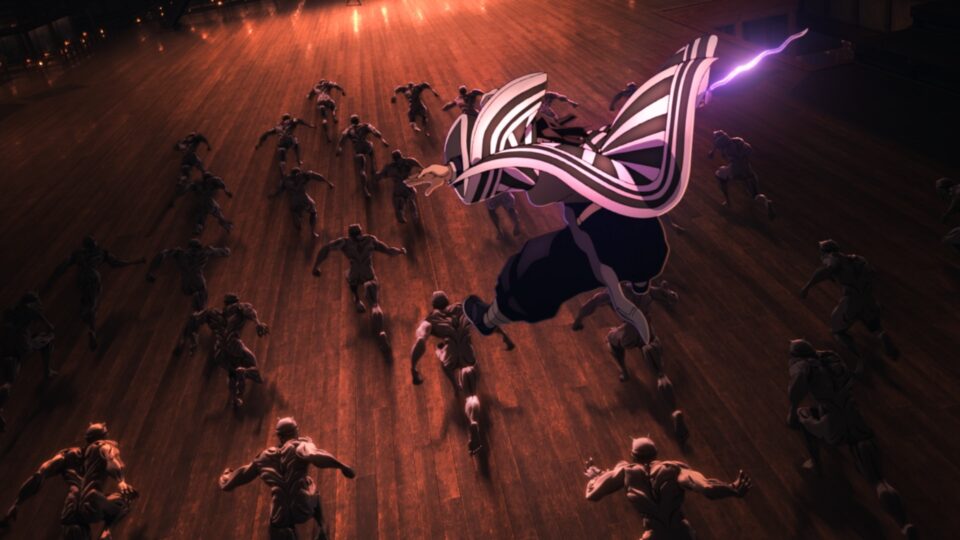
Curtains rise for the first of Kimetsu no Yaiba’s final three-part act. Slick, stylized and smooth, Ufotable’s film shows why some anime are best experienced on the big screen.
Kimetsu no Yaiba (or Demon Slayer, as it is called in English) is perhaps one of the top contenders for this generation’s Anime Big Three. It took the world by storm when the first season of the anime was released back in 2019, ironically just as the manga was wrapping up in May 2020.
The story follows Tanjiro, a former coal burner who turns into a demon slayer after the powerful demon Muzan massacres his family. With his sole surviving sibling, Nezuko, turned into a demon, Tanjiro joins the Demon Slaying Corps to kill Muzan and hopefully turn his sister human again. Kimetsu no Yaiba is their story.
The manga, serialized from February 2016 to May 2020, had an intricate plot that the anime adaptation faithfully follows. The film adaptation for the second manga arc, “Mugen Train”, was the highest-grossing film worldwide in 2020, and their new trilogy, the Infinity Castle arc, seems to be headed down the same path. In Japan, it’s already the highest-grossing film of 2025 so far.
The Infinity Castle arc constitutes a mammoth part of the manga, the showdown between Muzan and his elite demon coterie-The Upper Rank Six and Tanjiro’s group, the Demon Slaying Corps. The trilogy is named after the dramatic location it takes place in, which is Muzan’s bastion,- The Infinity Castle—an ever-expanding, ever-shifting pocket dimension.
With the Demon Slaying Corps trapped inside the Infinity Castle, will they emerge victorious or will they fall before they even find their enemy? They have until dawn and time is not on their side.
Originally, the Infinity Castle arc wasn’t the final arc, but the trilogy aims for a complete adaptation of the manga’s events by the end of the third film. This means that the trilogy will encompass two very large story arcs- Infinity Castle and the Sunrise Countdown arc.
As this arc is tying up all the loose ends in the story with a neat little bow, there’s a lot to process. In the first film alone, which is Demon Slayer: Kimetsu no Yaiba – The Movie: Infinity Castle – Part 1: Akaza Returns- three major fights are happening, one of which is left unfinished.
And these battles unfold simultaneously.
Not only does the film have to juggle the dynamics of these contained fights, but it also needs to keep the events moving in tandem with enough power to seamlessly flow into the next film. This is perhaps where the film’s greatest weakness lies – the pacing.
The events leading up to this story arc are highly emotionally charged. If there is one thing the mangaka Koyoharu Gotouge excels at, it is creating tragic villains who elicit sympathy despite their heinous crimes. The Infinity Castle arc thoroughly explores the motivations of each major player during the fights.
In a manga format where the battles spill over from page to page, panel to panel, the reader has enough time to soak up the story and the action. A trip down memory lane mid-fight in the manga makes sense and doesn’t interrupt the flow of the story, rather it adds to it.
Unfortunately for the film, this method takes away from the nail-biting tension on screen. There’s a lot of internal monologues and flashbacks interspersed with the fights that the intensity of the events on screen is affected. One can’t help but feel that breaking this film into two parts may have helped with pacing. The abrupt cuts from one group’s battle to the next, also hinder the narrative flow of what is arguably one of Kimetsu no Yaiba’s strongest story arcs.
Considering the plan to squeeze sixty-three chapters into the remaining two films of the trilogy, pacing is certainly going to be a tall order.
But what the film does excel at is sound design and cinematography, Ufotable’s (the studio behind the film’s) greatest strength.
This is definitely one of those films that has to be seen on a big screen with surround sound. The audio is crisp and clear with war cries and soundtracks mixed seamlessly. The voice actors also do a great job of conveying the wide range of emotions that their characters feel.
The visuals of the gravity-defying Infinity Castle—with its long wooden hallways, stairways to nowhere, and the shoji (sliding doors) that shut with a thud of finality—are both foreboding and mesmerizing. There’s a lot of light and shadow play happening as the source of light in the film is from dim candles and the sparks that fly when the blades strike. Visually, it is stunning and there’s something very artful about how the gore and violence are showcased. Both the demons and the demon slayers weave around each other like skilled dancers rather than frantic adrenaline-fueled opponents.
Whether you think that Kimetsu no Yaiba’s plot is carried by the animation or strongly believe that Tanjiro’s story is strong enough to stand on its own two feet, it is undeniable that Infinity Castle is one of those anime films that really showcases the best of Ufotable’s animation prowess.

