At a 60-year-old glass factory in Bengaluru, this immersive multidisciplinary festival merged holographic art, interactive tech and boundary-pushing music with a core rooted in conservation
All Photos Courtesy of The Sixth Sense
As journalists, you know the word “immersive” is overused to the point where it’s almost passé, so we can’t be blamed if the idea of an immersive multidisciplinary festival like The Sixth Sense evoked skepticism. But after spending a full day at the inaugural edition of the festival, held at Bengaluru’s Alembic City inside the compound of a 60-year-old glass factory, we’re happy to report that organizers Swordfish can rightfully lay claim to creating a riveting setting.
Swordfish are also behind the eco-conscious music festival Echoes of Earth in Bengaluru. So if you’ve ever wondered where all their eye-catching, trippy stage decor of species ranging from hornets to spiders to boars went after each edition, turns out it was stored in a big warehouse. The Sixth Sense, which has been years in the making, gives these zoology-focused exhibits a new lease of life, turning them into the very first sight that greets attendees as they step into the sprawling warehouse space — sometimes alongside monkeys casually roaming around in what’s likely their habitat for most of the year.
Our day at The Sixth Sense kicked off with a panel curated by Rolling Stone India on Archiving India’s Music History, a dialogue on cultural preservation featuring Nehal Shah, founder of India Record Co, Leaxan Freitas, collector and archivist of Konkani and folk music, and Sarvar Kahlon, Programs Manager at the Indian Music Experience Museum. The conversation offered an insightful deep dive into everything from the emotional labour of restoring and safeguarding forgotten works to the most unexpected subgenres and discoveries they stumbled upon during the research and documentation process.
Conservation is very much at the heart of The Sixth Sense experience, with the biggest draw being an immersive art area that you could easily spend an hour (or more) getting lost within. Each piece functioned as a statement on the shifting dynamics of our relationship with the natural world, with some inviting touch to demonstrate cause and effect, while others placed us front and centre within fragile ecosystems pushed to their brink.
Whether it was Yash Chandak/Studio Cursorama’s Mycelial Imagination, where shifting light and sound on interactive screens echoed the underground intelligence of mycelial networks, or China-based artist Xi Luchen’s Ripples of the Flower, which revealed our impact on nature by inviting visitors to touch a vase of chrysanthemums and trigger visible energy shifts across a giant LED screen, interaction was key at The Sixth Sense.
Beyond these tactile works, other installations enveloped us in more contemplative questions, with benches placed in certain zones to encourage people to sit down and absorb it all. One of the most arresting pieces was Adrift by media artist Sasha Kojjio and creative producer Alisa Davydova of Barcelona-based Metanoeia Studio, which simulated the melting of glaciers through a looping audiovisual display of sweeping waterfalls that splintered into jagged fragments, intensified by a reflective pool of water below the screen.
Another standout was The Infinite Seed by Studio Blackgrids, a mirrored room of volumetric LED strips stacked to multiply points of light into a dizzying sense of cosmic infinity, a meditation on how nature is the ultimate master of “copy-paste.”
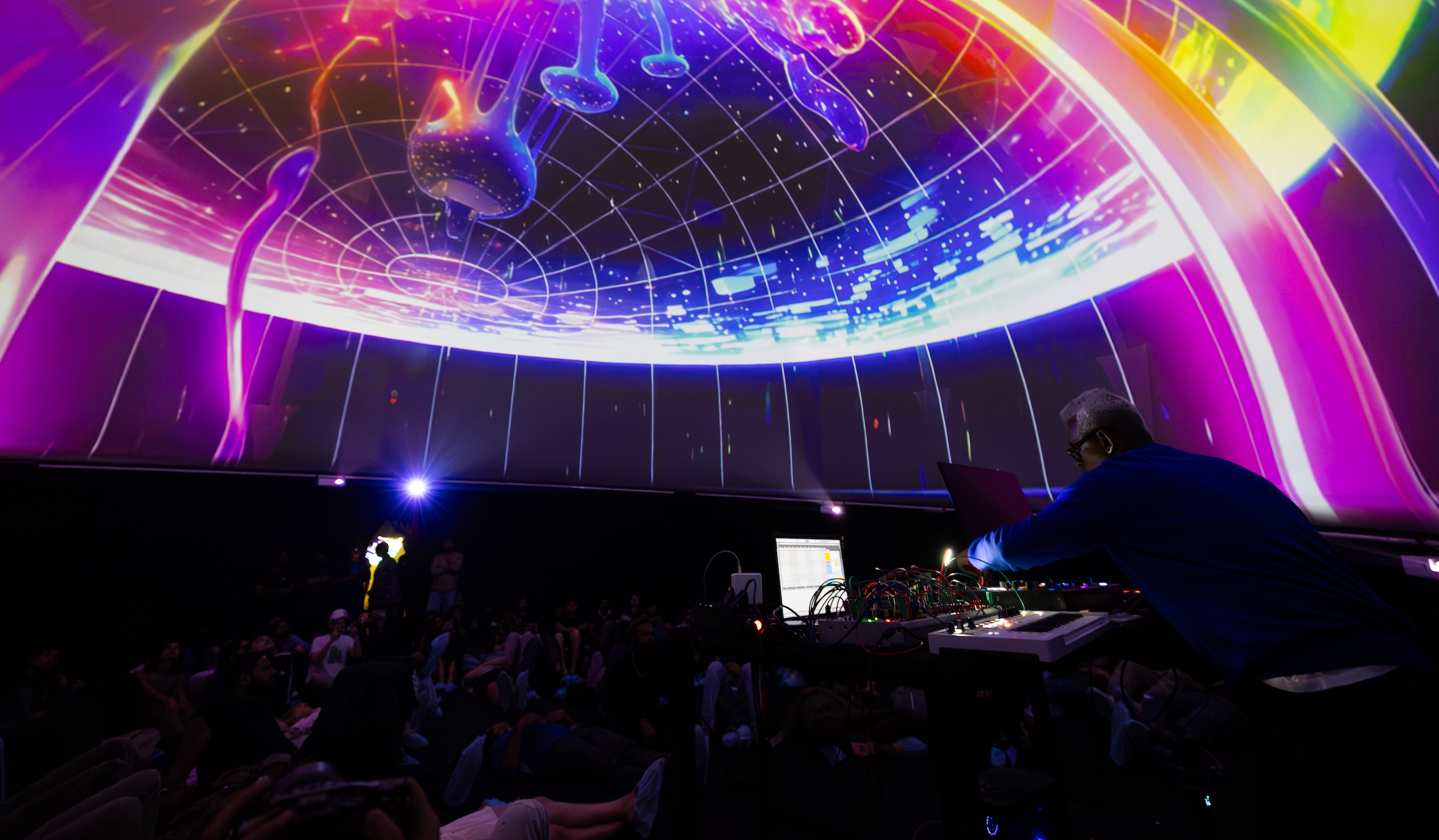
Not everything demanded reciprocity, though. Rolling Stone India Reset took over the festival’s 360-degree dome with two full-tilt immersive sessions designed as a moment of pause and introspection. The special gig series kicked off on Feb. 13 with a 60-minute drift through speculative futures by Elsewhere, the duo comprising Hyderabad-based electronic composer, DJ, and sound designer Murthovic and media artist and creative director Thiruda. Here, bioacoustic field recordings, ecological archives and generative AI visuals imagined India’s vanishing ecosystems preserved as digital memory in 2063.
On Sunday, Feb. 15, the dome was packed for French visual and new media artist Milkorva aka Nicolas Michel’s The Rising Dusk, with sound composed by Valentin Fayaud. All you had to do was lie down and look up as you were guided by swirling, ever-changing patterns synced perfectly with the ebb and flow of ambient sounds, which occasionally veered into eerie textures to keep attendees on edge. Until we get something like The Sphere, this was the perfect example of how music and visual art can make a powerful, entrancing experience.
It was only after sunset that a festival like The Sixth Sense truly whirred to life. This was perhaps most pronounced in Tessellation by Stefan Ihmig’s studio RE:SORB, which turned the factory’s old silo — once a place to store raw materials — into a canvas that danced with 3D holograms. The inside of the silo housed a somewhat unsettling but hypnotic laser-driven show on the journey of diamonds, while Ephemeral Tomorrow’s SIGNALS turned live bat calls into rippling sounds and streaks of moving laser light across the silo’s surface.
At the centre of the performance arena stood The Banyan Tree, an installation by production designer and new media artist Stephen Bontly that deployed light, sound and technology to explore themes of connection, resilience and continuity. A digital homage to Bengaluru’s legendary Dodda Alada Mara, it felt almost extraterrestrial, its aerial roots subtly reacting to the people moving around it.
By night, the piece became the backdrop for the festival’s music programming, which leaned into sonic storytellers who felt like natural extensions of the festival’s experimental core. Sets by Batavia Collective, Barker and Vieux Farka Touré anchored the first weekend, with everything from club abstractions to desert blues that carried both history and forward motion.
The highlight of the weekend music-wise was sitarist-composer Niladri Kumar, whose soaring zitar keys cut through with precision and fire. Joined by the likes of jazz maestro Louis Banks and percussion powerhouse Gino Banks, the set moved between meditative passages and explosive bursts of improvisation that kept the crowd locked in. The weekend closed on a high when Kumar was joined on stage by Vieux Farka Touré, a masterful collision course that felt both spontaneous and celebratory.
The Sixth Sense runs until Feb. 22, with weekend two bringing in a slate of artists including Max Cooper, Panelia, Audio Units and Luke Slater. If the opening stretch is anything to go by, it’s that this is a space that asks you to look longer and listen closer, marking the first time we’ve seen a tech-forward festival rooted in ideas of nature and conservation operate at this scale in the country.
Rolling Stone India is a Culture Partner at The Sixth Sense
As the world celebrates J-Hope’s 32nd birthday, we peel back the ‘sunshine’ layers to find…
In an emotional new interview, the Dead & Company singer-guitarist reflects on sharing a stage…
Filmed in front of a live studio audience, the special will feature an in-depth interview…
The singer is encouraging fans to wear a bald cap at his headlining show in…
The musician finally shares her “favorite song” from her long-awaited album, Stove
During her show in Paris on Sunday, 65 fans with tickets were reportedly denied entry



