


‘Trigger’ Reflects Society’s Relationship with Violence and Mental Health
The new Netflix series is a timely commentary on violence and mental health by exposing societal failures and collective trauma

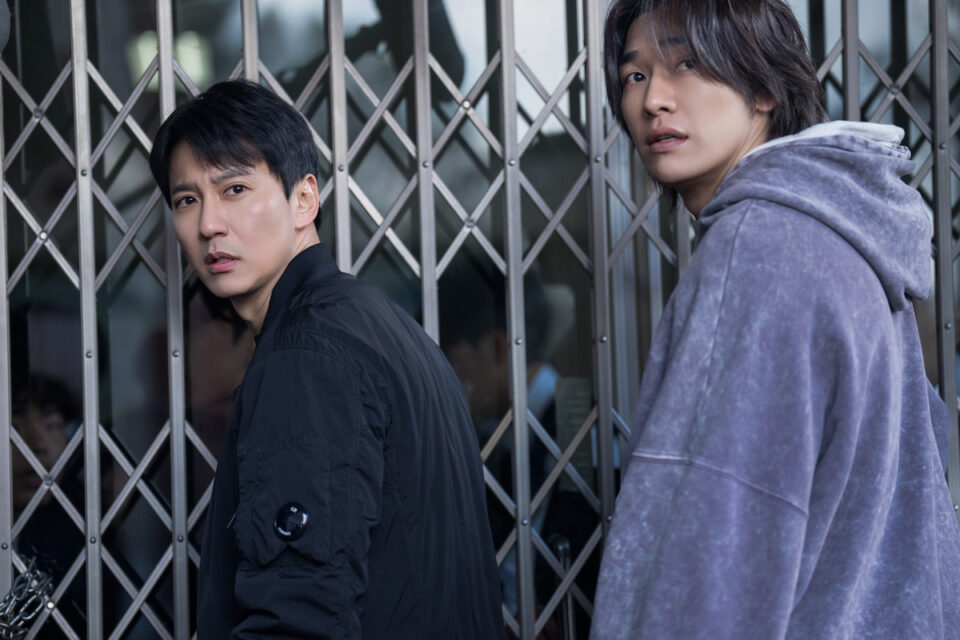
Kim Nam-gil (left) and Kim Young-kwang (right) in a still from 'Trigger.' Photo: courtesy of Netflix.
Have you ever felt like you’re suffocating emotionally, like there’s no escape from the crushing pressure and that it can push you over the edge any time? Trigger raises similar questions: what triggers a person to act recklessly, as recklessly as picking up a gun and pulling the trigger? Is it a momentary lapse in judgment, or is it years of suffering, frustration, and anger causing such an insane outburst?
The drama interrogates through its characters’ hardships while highlighting the constantly shifting lines between justice and revenge. It’s also what I’m trying to dissect here: Trigger’s portrayal of trauma, morality, and the search for justice, and what it says about our society’s relationship with violence and mental health, making it so relevant as a show.
Trigger opens with illicit firearms suddenly appearing in South Korea, a country with strict gun laws, and causing a surge of mad violence. As the situation spirals out of control, we are introduced to Officer Lee Do (Kim Nam-gil), a former soldier haunted by his past, who witnessed his family’s brutal murder and later struggled with the weight of taking lives as a sniper. He is now a cop who avoids using a gun until the escalating gun violence forces him to take up his rifle again.
On the other side of the spectrum, Moon Baek (Kim Young-kwang) is a manipulative arms dealer who was trafficked for his organs as a child and later raised by a criminal syndicate. Now, dying of cancer, he returns to Korea and ignites violence through free distribution of illegal weapons to disenfranchised, frustrated people—including a civil service exam candidate under stress, a bullied high school student, an overworked nurse, and a grieving mother seeking justice for her son’s death. It’s not for any financial gain but entirely for revenge—he wants to get back at the society that abandoned him and prove that the “trigger” is inside everyone and that society by nature is prone to chaos.
In a Netflix release, director Kwon Oh-seung talked about the dark underbelly of society that Trigger portrays. He emphasized the importance of making the characters relatable, saying, “It was important that the characters who eventually pick up a gun were not special or extreme. They had to be ordinary people we could easily come across in real life.” He believes this approach highlights the unsettling reality that anyone can be pushed to the edge. Kwon also touched on how habituated we’ve become to social issues these days, explaining, “We have become desensitized to many issues in our society because we are too often exposed to them through the news.” And so, the series explores pressing issues like class disparities and flawed justice systems and connects them and the resulting violence directly to the mental and emotional struggles of its characters.
The Cycle of Trauma and the Breakdown of Morality
In Trigger, we see how past and present trauma can snowball into societal failures, which ultimately push vulnerable people to the breaking point. Yoo Jung-tae (Woo Ji-hyun), appearing for the civil service exam in the very first episode of the series, is already on edge, dealing with disrespect and constant noise from his hostel neighbors. It’s the little things that get to him and slowly build up into a toxic rage. The system is supposed to support him because he’s also suffering from mental illness, but it fails miserably. When an illegal gun lands in his hands, it’s like the final nail in the coffin. He snaps, resulting in a bloody shooting spree in his building.
Jung-tae sounds the alarm on the influx of illegal guns and becomes the first prime example of what Moon Baek believes—“there’s a trigger in everyone’s heart.” Subsequently, an unresponsive or corrupt justice system reveals itself to have wronged every person who receives a gun. For example, Oh Kyung-sook (Gil Hae-yeon) is a mother protesting for justice and an apology after her son dies in a workplace accident, but her efforts prove futile and ultimately drive her to pick up the gun. Trigger, therefore, suggests that when people feel ignored or exhausted by a dysfunctional system, they may prioritize violent retribution over true justice, and that desperation is what Moon Baek exploits as opposed to Lee Do, who condemns gun violence and tries to protect others despite his own haunting memories. The difference between Lee Do’s empathy and Moon Baek’s vengefulness forces you to question whether pain can ever justify harming others.
Society’s Relationship with Violence
By setting its premise in South Korea—a country with a near-total ban on civilian firearms—Trigger offers a hypothetical scenario about the fragility of social order. It portrays Korean society as a tinderbox of pent-up rage and discontent, over problems of inequality, school bullying, and economic hardships. The illegal guns only act as a catalyst that ignites the violence that was already simmering beneath the surface. Director Kwon has explained that the show is about what happens when everyday issues meet a loaded gun, suggesting that a society that has become too numb to its problems may not realize how unstable it is until it’s too late. In this context, the story can be considered a critique of American gun violence, which is marked by a high rate of gun ownership. According to a Pew Research Center report, “The Second Amendment to the United States Constitution guarantees the right to bear arms, and about a third of U.S. adults report personally owning a gun,” highlighting the horror of easy gun access. For a Korean audience, widespread gun violence is a terrifying and surreal concept. But for many others worldwide, it’s an uncomfortably familiar reality.
Mental Health and Societal Neglect
Trigger highlights how a lack of attention to mental health can have catastrophic consequences for individuals and the wider community, whose desperation and emotional turmoil make them susceptible to Moon Baek’s manipulation—in fact, they become the “triggers” Moon Baek has been looking for to avenge his years of anger. For many of the show’s desperate characters, such as Seo Yong-dong (Son Bo-seung), a routinely bullied student, the gun represents a shortcut to regain a sense of power and control in a world where they keep feeling overlooked and powerless. But eventually, it’s an illusion that brings in more pain. By making ordinary, broken people the ones pulling the trigger, the series reminds us that mental health issues are a widespread, not a fringe problem, and the characters’ actions are a wake-up call for a society that often overlooks the quiet struggles of its most vulnerable members.
Triggering Change: One Act of Compassion
In the tense finale segment of Trigger, Lee Do stands at a crossroads at the “Free Guns” rally, where Moon Baek’s provocation could have led to more bloodshed. Even so, when Lee Do sees a frightened child holding a gun, he drops his weapon and embraces him—a moment that’s broadcast live, giving hope and inspiring people to surrender their guns. The moment underlines that peace can’t come from force but from a choice to prioritize empathy. Trigger, at the end of it all, encourages viewers to walk in the shoes of those who might resort to guns, fostering understanding and a deeper appreciation for the value of peaceful choices.