Short answer: No
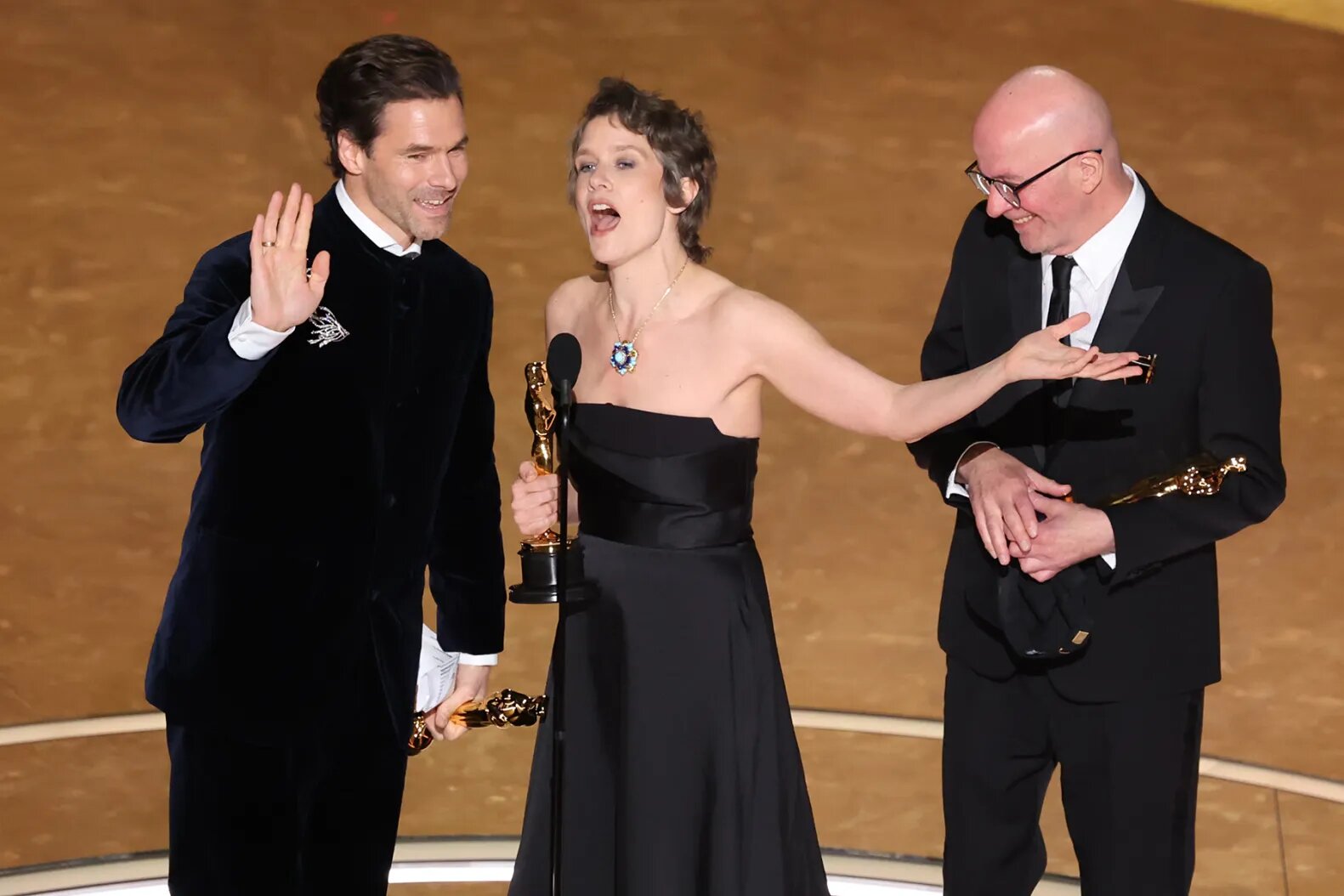
Clément Ducol, Camille, Jacques Audiard at the 97th Oscars held at the Dolby Theatre on March 2, 2025 in Hollywood, California. Rich Polk/Penske Media/Getty Images
The Emilia Pérez saga is over. Thank God. At Sunday night’s Academy Awards, the controversial film ended its fraught awards-season run with two trophies: One went to Zoe Saldaña for Best Supporting Actress; the other was for Best Original Song for “El Mal,” a track that sounds like it was written with a French-to-English-to-Spanish translation tool worse than ChatGPT.
You might recall the two people singing onstage at last night’s show as they accepted that award, inspiring a collective cringe from viewers. They were Emilia Perez‘s French musical directors, Camille and Clément Ducol. If they deserved a trophy, it was for the music’s production and arrangements (they clearly know what they’re doing) — and how they were able to salvage Karla Sofía Gascón’s vocals with voice filters. But the lyrics and themes of their songs left much to be desired.
The same issues many people raised with the film — the lack of a Mexican perspective within a story set in Mexico, the surface-level storytelling about trans experiences, and Selena Gomez’s limited Spanish — also affected the soundtrack. Its only direct tie to Mexico City, where much of the film’s action takes place, is the opening song, “Fierro Viejo,” which borrows ambient noise from Mexico City yet never returns to the sounds of Mexico. What a missed opportunity to tap into música mexicana’s rise, especially when so many of that genre’s artists — including local musicians — are already singing about the same narco-culture the film explores. Or at least feature the strums of a charcheta somewhere in there?
“El Mal,” the Oscar-winning song, comes about halfway through the film. In it, Saldaña’s character Rita uses Mexican slang that feels forced, full of colloquialisms — like “chingar” and “pinche” and “bombón” — that seem pulled from a checklist. Gascón’s operatic vocals, meanwhile, are artificially enhanced by Auto-Tune. Perhaps the scene with “El Mal” was most meaningful in the film, as it sees Rita weaving between tables of politicians at a gala, calling them out one by one. As Camille accepted the Academy Award on Sunday, she described “El Mal” as a song “meant to denounce corruption,” given that the track is ultimately political. All the more ironic, then, that she squandered the opportunity to address the recent horrific attacks on trans people, the marginalized group at the heart of the film, when she was onstage. (Zoe Saldaña also neglected to mention trans people during her acceptance speech, and later disappointed many when she said she didn’t feel the heart of the film was Mexico after a Mexican reporter asked about the country feeling “hurt” by the film. Also backstage at the ceremony, a Rolling Stone reporter asked director Jacques Audiard why there had been no mention of the trans community by the filmmakers. He responded: “Since I didn’t win Best Film or Best Director, I didn’t have the opportunity to speak, but had I had that opportunity, I would have spoken up.”)
Then there are the Selena Gomez songs: If Gomez’s inability to roll her Rs wasn’t so distracting, “Mi Camino” could’ve been a perfect pop song, and even a solid Oscar contender. The words to the track’s chorus, “Quiero quererme a mí misma/Querer, sí, mi vida,” are simple (like many lyrics in the film) but ultimately catchy. However, Gomez’s lack of fluidity with Spanish prevents the track from ever landing. There’s also “Bienvenida,” which is built entirely off of a poor translation. The phrase they seem to have been looking for was “de nada,” which translates to “you’re welcome.” Instead, they used “bienvenida,” which literally means “welcome.” This small but crucial translation error could have easily been fixed with a more accurate understanding of the language, or if more Mexican people had been involved.
It’s especially baffling to see Emilia win an award for music after one of its most viral clips came from people mocking the song “La Vaginoplastía,” which reduced gender-affirmative care to an elementary explanation of “Man to woman… From penis to vagina.” (Not to mention that the singing was pretty horrible in that, too.) While “La Vaginoplastía” is the most obvious example of how insensitively trans issues were addressed, the problems continued on “El Amor.” Camille and Ducol misinterpret the nuanced, intense feelings of gender dysphoria as Emilia feeling “half him, half her,” and “half jefe” (masculine) and “half queen.” Put simply by GLAAD: It’s just “not good trans representation.” And, to quote RuPaul’s Drag Race’s Katya, who constantly dragged Emilia on X, “These are godless times.”
Emilia Pérez winning for Best Original Song felt distasteful. But it’s not entirely surprising, considering the Academy lacks a lot of representation from the communities Emilia Pérez aimed to portray: trans women, struggling workers, and Mexicans. With the music sharing the same problems of the film, this Academy Award win will always feel like it’s carrying an asterisk.
From Rolling Stone US.
New album is set for a March 6 release date
The highly-anticipated collection of songs marks the group’s first new music since their 2022 album,…
Blake Slatkin, Rami Jaffee, and Pino Palladino also joined them for the F1 song’s performance
"Roommates," paired with a video that reminds us of her "Come Clean" days, is one…
Song previews new album, also titled Into Oblivion, due this spring
The second edition of the music conference and showcase festival takes place in Mumbai from…

